What is EcoVadis and is it worth it for non-EU suppliers?
Your EU buyer has asked you to complete an EcoVadis assessment. This guide explains what EcoVadis is, what the process involves, what a score actually demonstrates, and whether completing it genuinely helps your compliance position.
This article is for informational purposes only and does not constitute legal advice. Consult a qualified legal professional for advice specific to your situation.
- EcoVadis is a commercial rating company, not a regulator or certification body, and its medals are a marketing artefact rather than a regulatory designation. When an EU buyer requests an EcoVadis score, they are asking a supplier to participate in their own supplier assessment programme, which is a response to the buyer's CSRD and CSDDD exposure. Whether that programme actually satisfies those obligations is a separate question the score does not answer.
- The score reflects a document based self-assessment reviewed by analysts, not an on-site audit. It rewards documented practice over stated policy, weighted toward actions and results, but it does not verify what happens inside a supplier's facilities and it does not persist independently of the subscription. Stop paying and the score disappears, which makes it a recurring commercial credential rather than a durable compliance record.
- A high EcoVadis score does not cover what EU law specifically requires. It does not include EUDR's geolocation and deforestation documentation, the detailed Scope 3 data CSRD value chain reporting requires, or the full due diligence cycle CSDDD sets out. It is more useful as a communications tool with EU buyers than as compliance infrastructure for EU regulation.
- Whether it is worth the roughly three thousand dollar annual fee depends on how many EU buyers require it and how strong the supplier's underlying practices already are. A single score is shareable across every buyer on the platform, which improves the economics for suppliers with multiple EU relationships, but for a supplier serving one buyer with already solid practices, it is worth asking whether existing certifications or audit reports would satisfy the same requirement.
You have received a request
A procurement team at one of your EU customers has sent a request asking you to complete an EcoVadis assessment. The message may have been brief. It may have arrived alongside a supplier code of conduct and a deadline. It may have implied that continued supply depends on completing it.
Before you spend money or time on the process, it is worth understanding what EcoVadis is, what the score actually measures, what it costs, and whether completing it addresses the regulatory requirements your EU buyer is responding to.
What EcoVadis is
EcoVadis is a Paris-based company that sells sustainability ratings to corporate supply chains. It was founded in 2007 and now rates approximately 55,000 companies. Its product is a scorecard: a numerical rating from 0 to 100, delivered to the supplier and shareable with buyers through a subscription platform.
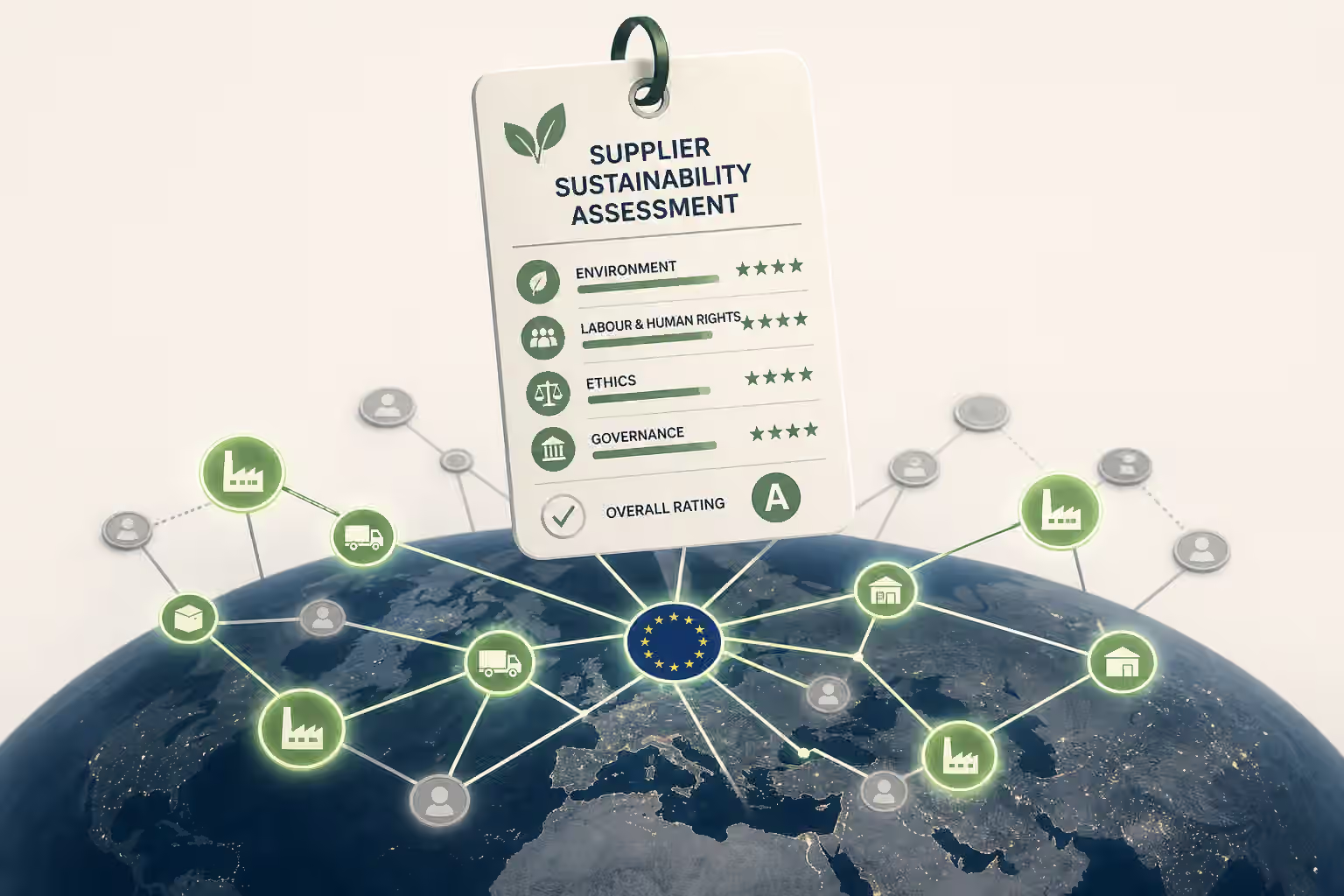
The scorecard covers four themes: environment, labour and human rights, ethics, and sustainable procurement. Scores above defined thresholds earn medal recognition at bronze, silver, gold, and platinum levels. The medal is a marketing artefact of the EcoVadis system, not a regulatory designation under any EU law.
EcoVadis is not a regulator, an audit body, or a certification scheme. It is a commercial company selling a data product that EU buyers use to screen their supply chains. When a buyer asks you to get an EcoVadis score, they are asking you to participate in their supplier assessment programme. Whether that programme satisfies their EU regulatory obligations is a separate question, discussed below.
How the assessment works
The process begins when the supplier registers on the EcoVadis platform and pays the annual subscription fee. EcoVadis then sends a questionnaire tailored to the supplier's industry category and company size. The questionnaire covers the four themes and asks about policies, actions, and results across each area.
The supplier completes the questionnaire and uploads supporting documents: sustainability policies, management system certifications, audit reports, employee data, environmental measurements, or other evidence of the practices described. EcoVadis analysts then review the submission alongside publicly available information about the company, including news coverage, NGO reports, and industry data.
The resulting score reflects three pillars weighted as follows: policies (25%), actions (40%), and results (35%). This weighting is intentional. A company that has formal policies but no evidence of implementation scores lower than a company that can document what it actually does. The system rewards documented practice over stated intention.
Assessment turnaround is typically several weeks after submission. Suppliers consistently flag slow turnaround as a weakness, particularly when facing buyer-imposed deadlines.
The process is a verified self-assessment. It is not an on-site audit. EcoVadis does not send inspectors to your facilities. The review is document-based: analysts assess what you submit and cross-reference it with external information. The quality and completeness of what you upload directly affects your score.
What the score demonstrates
The EcoVadis score demonstrates that your company has been through a document-based review of its ESG policies, actions, and results, and received a rating from a third-party commercial platform. This is genuinely useful for EU buyers who need to screen large numbers of suppliers and want a standardised way to compare them.
What the score does not demonstrate:
It does not certify that your operations comply with any specific EU regulation. EcoVadis commissioned a private legal opinion arguing that its platform supports CSDDD compliance, but no EU regulator has confirmed this. The EcoVadis medal is explicitly described by the company as a recognition of performance, not a regulatory certification.
It does not involve on-site verification. The score reflects what you have documented and submitted, reviewed against public information. It does not reflect what an auditor observed in your facilities.
It does not persist independently of your subscription. If you stop paying, the score disappears from the platform. A buyer who relied on your score for their compliance programme would no longer be able to access it. This creates a dependency on continuous payment rather than a durable compliance record.
It does not cover the specific documentation requirements of EUDR (geolocation data, deforestation evidence), the detailed Scope 3 emissions data required for CSRD value chain reporting, or the full due diligence cycle that CSDDD requires.
Who requires EcoVadis and why
EcoVadis is most common in industries where large EU multinationals have formalised supplier sustainability programmes. The companies most frequently cited as requiring EcoVadis include BASF, L'Oreal, LVMH, Johnson and Johnson, Renault, and similar large industrial and consumer goods companies.
The underlying reason is regulatory. CSRD requires large EU companies to report on sustainability risks and impacts in their value chains. CSDDD requires them to conduct due diligence on their suppliers. Both regulations increase the pressure on EU procurement teams to gather structured sustainability data from their suppliers at scale. EcoVadis provides a standardised mechanism to do this.
The request you received is therefore your EU buyer responding to their own regulatory exposure. They need to be able to demonstrate to their auditors, their board, and potentially regulators that they have a supplier assessment programme in place. Your EcoVadis score becomes a data point in that programme.
This context matters for how you think about the request. Completing EcoVadis primarily serves your buyer's compliance programme. It may also be useful to you as a structured baseline assessment of your ESG practices, and as a credential you can share with other buyers who use the same platform. But it is not a substitute for building your own compliance infrastructure against the requirements of EU law.
What it costs
EcoVadis does not publish its pricing. Suppliers typically pay approximately $2,800 to $3,000 per year for a basic plan. This is an annual recurring cost: the score disappears if the subscription lapses. There is no free trial and no self-guided demo before purchase.
Enterprise buyer contracts are negotiated separately and typically structured around the volume of suppliers assessed. The buyer's cost is not your concern directly, but it is relevant context: EcoVadis is a significant commercial operation generating $162 million in revenue in 2024, built on recurring fees from both sides of the supplier-buyer relationship.
For suppliers in lower-income markets or smaller businesses, the annual fee is a meaningful cost for a credential that primarily serves the buyer's needs. If you supply multiple EU buyers who all use EcoVadis, the single score is shareable across them, which improves the value proposition. If you supply only one EU buyer and they are the only reason you are considering it, the cost-benefit calculation is less clear.
Whether it is worth it
The honest answer depends on your situation.
If multiple EU buyers require EcoVadis as a condition of supply, and the combined value of those relationships is significant, completing it makes commercial sense. A single score on the platform is shareable with all buyers who use EcoVadis, which reduces the per-buyer cost of the credential.
If one buyer has requested it and the relationship is at risk without it, you face a straightforward commercial decision. EcoVadis will not tell you whether your practices are legally compliant, but it will satisfy that buyer's supplier screening requirement.
If you are trying to build genuine compliance with EU sustainability law, EcoVadis is not sufficient on its own. It covers some of the ground that CSRD value chain reporting and CSDDD due diligence require, but it does not cover all of it, and it does not start from the legislative text to tell you where your specific gaps are. An EcoVadis score is more useful as a communications tool with EU buyers than as a compliance infrastructure for EU regulation.
If you are a smaller supplier being asked to pay $3,000 per year for a score that serves one buyer's procurement team, and your practices are already reasonably strong, it is worth asking your buyer whether alternative documentation, such as existing third-party certifications, audit reports, or a structured self-assessment, would satisfy their requirement. Some buyers are more flexible than the initial request implies.
What to do before you start the assessment
If you decide to proceed, the most common mistake is beginning the questionnaire before gathering your evidence. The EcoVadis scoring system rewards documented practice. If you have good practices but have not formalised them in written policies, procedures, or measurement records, your score will not reflect your actual performance.
Before starting the questionnaire:
Identify what written policies you have covering environmental management, labour and human rights, anti-corruption and business ethics, and supplier management. If formal policies do not exist, determine whether your practices could be documented quickly.
Gather any existing certifications, such as ISO 14001, ISO 45001, SA8000, or equivalent, as these provide strong evidence for relevant sections.
Collect any data you have on environmental performance: energy consumption, emissions, waste, water use. Even approximate figures are more useful than blank fields.
Review your industry category on the EcoVadis platform before beginning, as the questionnaire content varies significantly by sector and the weighting of specific questions differs accordingly.
The gap between having good practices and being able to document them for the platform is usually larger than suppliers expect. Allowing adequate time for document gathering before starting the questionnaire reduces the risk of a score that underrepresents your actual position.
The larger compliance question
An EcoVadis score tells your EU buyer where you sit in their supplier risk ranking. It does not tell you whether your operations comply with CSRD, CSDDD, or EUDR. These are different questions that require different tools.
EU sustainability law imposes specific requirements: Scope 3 emissions data in structured form, documented due diligence processes with evidence of preventive and corrective action, geolocation and deforestation documentation for covered commodities. EcoVadis collects information relevant to some of these areas but is not designed around the legislative text of any specific regulation.
For non-EU suppliers who want to understand what EU law actually requires and where their current practices fall short, the starting point needs to be the legislation itself.
A detailed explanation of what CSRD supply chain obligations mean for non-EU suppliers is available here: CSRD supply chain obligations: what non-EU suppliers need to know.
Verdandi monitors EUDR, CBAM, CSRD, CSDDD and more continuously — so non-EU businesses touching EU markets are working from current requirements as deadlines, benchmarks, and scope thresholds change. Start for free.
This article is part of a series on the supply chain sustainability platform landscape. See also: EcoVadis vs Sedex: which one does your EU buyer actually need? and Does an EcoVadis score satisfy CSRD supply chain reporting requirements?.
📋 Track EU sustainability regulation continuously
Verdandi monitors EU sustainability regulation and delivers personalised alerts anchored to verified official sources.
14-day free trial. No credit card required.