What does it mean for a regulatory intelligence tool to be source-anchored?
Many regulatory intelligence platforms claim to use official sources. Source anchoring means something specific: every claim traces back to a retrievable official document with a verifiable identifier. Here is what that looks like in practice and why the distinction matters for compliance.
This article is for informational purposes only and does not constitute legal advice. Consult a qualified legal professional for advice specific to your situation.
- "Based on official sources" is a weak claim that almost every regulatory intelligence platform can truthfully make, but it does not mean every output traces back to a specific, retrievable, currently-in-force document. Source anchoring is the stronger and more specific standard: every claim must resolve to a stable identifier, a CELEX number and article, that a reader can independently verify.
- Genuine source anchoring rests on three properties working together: retrieval from a defined official corpus rather than generation from training data, a stable document identifier attached to every output, and strict separation between adopted law, pre-legislative proposals, and supervisory guidance. A retrieval-based system that lacks the current text of a document says so; a generative system trained on regulatory content has no equivalent mechanism for flagging what it doesn't actually have.
- Several common architectures use the language of source-basing without meeting the standard: analyst-curated platforms where the source sits in the background of an interpretation, AI tools trained on regulatory text that cannot say which version of a document they're drawing on, and alert-only systems with no way to interrogate the underlying provision. All three leave the compliance professional either relying on someone else's reading or unable to trace a claim back to a specific source at all.
- The distinction matters most at the point a compliance decision needs to be documented: "the alert system flagged a change" does not satisfy a supervisory review, while a citation to a specific article of a specific CELEX-identified document does. Source anchoring has to extend beyond adopted legislation into the supervisory guidance layer, EBA guidelines, ESMA opinions, EIOPA recommendations, since these operate on a comply-or-explain basis that is close to binding in practice even though their formal legal status differs.
- Three tests distinguish genuine source anchoring from the marketing claim: source transparency (article-level citation, not just a regulation's name), currency (a continuously updated corpus with visible publication dates), and scope discipline (clear labelling of adopted law versus proposals versus guidance). Most platforms that call themselves source-based pass the first test only in a weak form and fail the other two entirely.
"Based on official sources" is not a compliance-grade claim
Most regulatory intelligence platforms, including enterprise monitoring tools and AI-powered research products, describe themselves as drawing on official sources. The claim sounds reassuring. It rarely means what compliance professionals need it to mean.
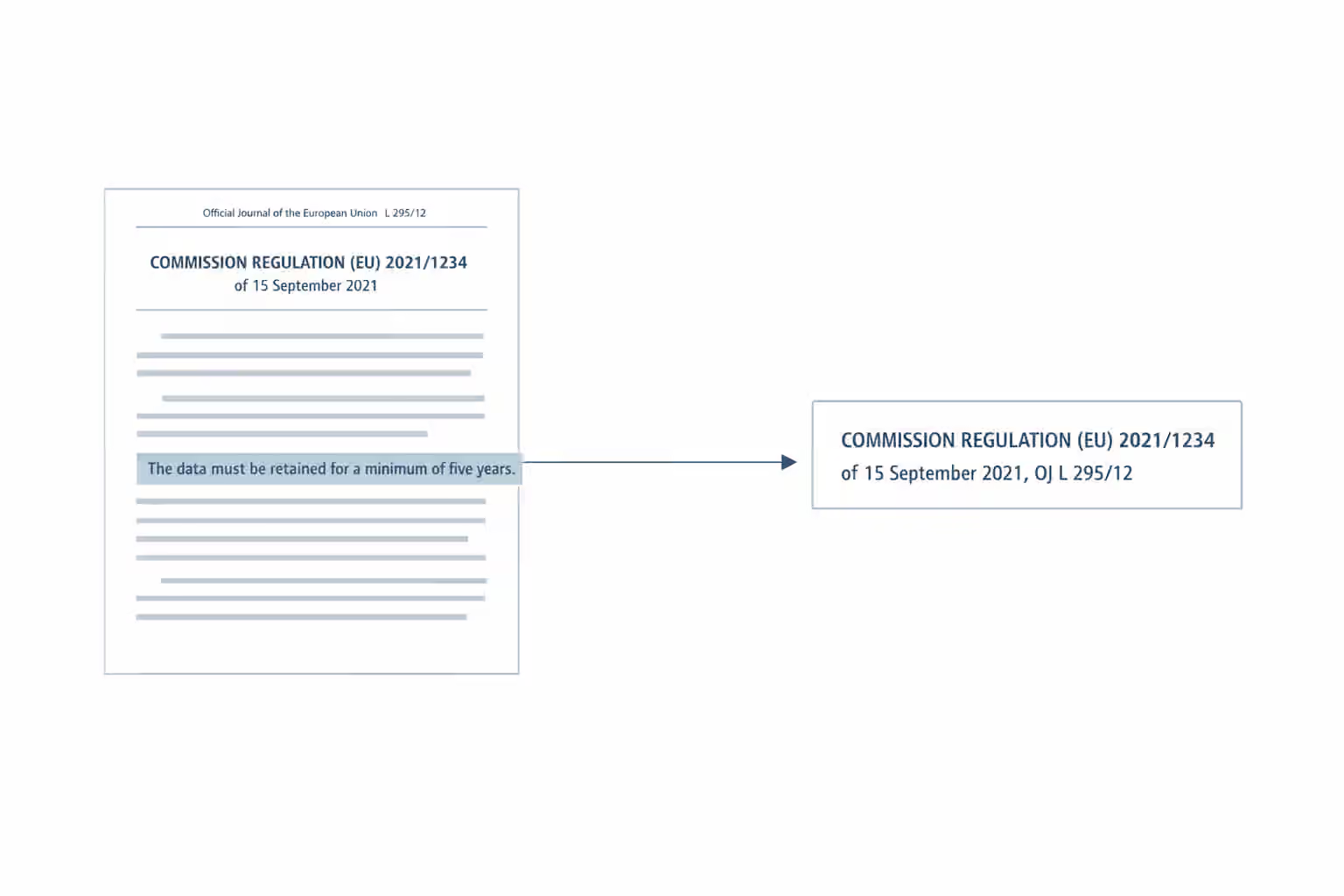
There is a significant difference between a system that has ingested official sources at some point in its development and a system that retrieves directly from verified official documents every time it produces an answer. There is a further difference between a system that cites a regulation by name and one that cites a specific article of a specific CELEX-identified document published on a specific date in the Official Journal of the European Union.
Source anchoring is the term for the second standard. It describes a specific architectural property: every claim produced by the system can be traced back to a retrievable official document, with a stable identifier, that any reader can independently verify. That is a materially different thing from "informed by official sources" or "based on the current regulatory framework."
This article explains what source anchoring requires, why it matters for compliance use, and how to distinguish a genuinely source-anchored system from one that uses the language without the underlying architecture.
What source anchoring requires in practice
A source-anchored regulatory intelligence system has three properties that work together.
Retrieval from verified official documents
The first property is that the system's outputs are produced by retrieving specific documents from a defined official corpus, not by generating text from training data or analyst memory. The distinction matters because retrieval-based systems know what they have and what they do not have. If a document is not in the corpus, the system cannot produce confident claims about it. It can flag the gap. It cannot fill it with a plausible approximation.
A generative system trained on large volumes of text including regulatory content has no equivalent constraint. It produces text consistent with patterns in its training data. That text may accurately reflect a current regulation, an earlier draft, a commentary on a draft, or a blend of all three. The system has no mechanism for flagging the difference, because it does not know which documents it is drawing on for any given claim.
For EU financial regulation specifically, this distinction is not abstract. Regulatory technical standards are finalised months or years after the framework regulation is published. A generative system trained before an RTS was finalised may describe the requirements based on the consultation draft, which may differ in material ways from the adopted text. A retrieval-based system built on the current EUR-Lex corpus either has the adopted RTS and cites it, or it does not have it and says so.
Stable document identifiers in every output
The second property is that every output includes a stable, retrievable identifier for the source document it is drawing on. In EU financial regulation, that means CELEX identifiers.
A CELEX identifier is the unique reference code assigned to every EU legal instrument published in the Official Journal. It is stable: the same document always has the same CELEX number, regardless of where it is cited or how it is described. Anyone with a CELEX number can go directly to EUR-Lex and read the specific document being referenced.
The difference between "under DORA" and "under Article 30(2) of Regulation (EU) 2022/2554 (CELEX: 32022R2554)" is not a formatting preference. It is the difference between a claim that is verifiable and one that is not. The first reference points to a body of legislation that has been amended, supplemented, and interpreted in multiple directions. The second points to a specific provision in a specific version of a specific document. A compliance professional who needs to demonstrate the basis for a compliance decision can defend the second reference. They cannot defend the first.
For a fuller explanation of how CELEX identifiers work and what they encode, see how to read a CELEX number.
Separation of adopted law from pre-legislative content
The third property is that the system maintains a strict separation between documents that are currently binding and documents that are pre-legislative or interpretive.
EU financial regulation exists at several levels simultaneously. A framework regulation may be fully adopted and binding. The regulatory technical standards under it may still be in draft. National competent authority guidance on implementation may reflect an interpretation that is contested in other member states. A consultation paper from a European Supervisory Authority may propose changes that will not take effect for two years, if adopted at all.
A source-anchored system labels each document at the level appropriate to its legal status. An alert about an adopted regulation carries a different status signal than an alert about a Commission proposal in trilogue, which carries a different signal again from an ESA consultation paper. When the two are mixed without distinction, the compliance professional reading the output cannot tell which obligations are current and which are contingent on legislative outcomes that have not yet occurred.
This is not a minor presentational issue. Acting on a pre-legislative document as though it were binding law can misdirect preparation effort. Failing to identify that a consultation paper will likely become binding within eighteen months can leave firms unprepared for obligations that were visible well in advance.
Why the architecture matters more than the marketing claim
Every serious regulatory intelligence platform claims to use official sources. The claim is almost always true in the weak sense: the platform has at some point drawn on official regulatory content. The question that matters for compliance use is a different one: when the system produces a claim about a regulatory obligation, is that claim retrieved from a specific current document that the user can independently verify?
There are several common architectures that fail this test while still being described as source-based.
Analyst curation with source documents in the background. Some enterprise platforms have regulatory analysts who read official publications and translate them into structured workflow tasks. The source documents are available in the platform, but the primary output is the analyst's interpretation. The user is relying on the analyst's reading, which may have been accurate when written but may not reflect subsequent amendments, NCA guidance, or Q&A clarifications. The source is present but the output is not grounded in it in a way the user can trace.
AI tools trained on regulatory content. A growing category of tools trains large language models on regulatory text and then queries those models for compliance answers. The training data includes official documents, so the tool can reasonably describe itself as informed by official sources. But the output is produced by inference from training weights, not retrieval from a current corpus. The model cannot tell you which version of a document it is drawing on, when that version was published, or whether a provision has been amended since training. For a detailed treatment of this failure mode, see why generic AI tools are unreliable for regulatory compliance research.
Alert systems with no query layer. Some platforms deliver accurate alerts about regulatory publications without providing any mechanism for querying the underlying documents. The alert may be sourced correctly. But a compliance professional who needs to understand how a specific provision applies to their firm has no way to interrogate it directly. They receive a signal that something has changed; they do not receive an answer to the compliance question that change raises.
A genuinely source-anchored system handles all three of these cases differently: retrieval from the current official corpus rather than inference from training data, citation at the CELEX identifier and article level in every output, and a query interface that allows the compliance professional to interrogate the specific provision directly.
What source anchoring looks like from a compliance professional's perspective
The practical difference shows up most clearly when a compliance professional needs to answer a specific question, not just receive a general alert.
Consider a compliance officer at a mid-sized investment firm who receives an alert that a new delegated regulation under AIFMD II has been adopted. An alert-only system has done its job: the compliance officer knows something has changed. But the question that follows immediately is a specific one: does this change affect how we calculate our leverage ratio for our main fund, and if so, how?
An analyst-curated platform may have a workflow task that says "review leveraged AIF disclosures" and a link to the source document. The compliance officer still has to read the document and interpret it for their specific fund structure.
A source-anchored query system allows the compliance officer to ask the specific question directly: "What does the new AIFMD II delegated regulation require for leverage calculation in a fund structured as ours?" The system retrieves the relevant provisions, synthesises what they require, and cites the specific article and CELEX identifier it is drawing on. The compliance officer can read those specific provisions, verify that the synthesis is accurate, and document the basis for their conclusion.
That last step, documenting the basis, is the point where source anchoring becomes most clearly necessary. A supervisory review or internal audit that asks how a compliance decision was made requires an answer that points to a specific provision in a specific document. "The alert system flagged a change" is not a sufficient answer. "Based on Article 15(3) of Commission Delegated Regulation (EU) 2026/XXXX (CELEX: 32026RXXXX), which requires X, we took the following action" is the standard the process needs to meet.
The supervisory guidance layer
Source anchoring for EU financial regulation cannot stop at adopted legislation. A significant part of what determines compliance in practice sits in the supervisory guidance layer: EBA guidelines, ESMA opinions, EIOPA recommendations, and the Q&A processes that supervisory authorities run to clarify how regulations apply in specific circumstances.
These documents do not have the same legal status as adopted regulations. They operate on a comply-or-explain basis: firms are expected to comply with EBA guidelines or explain to their national competent authority why they have not. The practical effect for most firms is close to binding, even though the legal character differs.
A source-anchored system that covers only adopted legislation is giving an incomplete picture of the current compliance environment. An EBA guideline on internal governance, an ESMA opinion on the application of MiCA to specific token structures, or an EIOPA recommendation on IORP governance can materially affect what compliance looks like in practice, regardless of their formal legal status.
The additional requirement for supervisory guidance is that the system must be clear about the distinction. A guideline cited in the same way as an adopted regulation, without flagging the different legal character, misleads the user about the nature of the obligation they are being asked to consider. Source anchoring for guidance documents means citing the document correctly, with its correct legal status, alongside the relevant adopted legislation where the two interact.
The three-test framework applied to source anchoring
The practical tests developed in why generic AI tools are unreliable for regulatory compliance research apply directly here.
Source transparency: Can the system tell you exactly which document a claim came from, with a stable retrievable identifier, at the level of a specific article or provision? Not "based on DORA" but "based on Article 30(2) of Regulation (EU) 2022/2554 (CELEX: 32022R2554)."
Currency: Is the system drawing on a corpus that is continuously updated from official sources, and does it tell you the publication date of each source it is citing? Source anchoring at a point in time is not source anchoring. A corpus that is not updated continuously fails the currency test even if it was accurate when assembled.
Scope discipline: Does the system maintain clear distinctions between adopted law, pre-legislative proposals, and supervisory guidance? A system that mixes these without labelling them correctly is compressing information that compliance professionals need to keep separate.
A system that passes all three tests is genuinely source-anchored in the sense that matters for compliance use. Most systems that describe themselves as source-based pass the first test in a weak form only, and many fail the second and third entirely.
What to look for when evaluating regulatory intelligence tools
When a regulatory intelligence platform claims to be source-anchored, the questions to ask are specific.
Does every output include a CELEX identifier for the document it is drawing on, or does it reference regulations by name only? Does the platform update its corpus continuously from official sources, and can it tell you when each source document was last retrieved? Does it clearly separate adopted regulations from Commission proposals from supervisory guidance, or does it present all of these under a single feed without status labels?
Can you ask a specific compliance question and receive an answer that cites the specific article it is drawing on? Can you follow that citation directly to the EUR-Lex document and read the provision being referenced? Can you use that citation to document the basis for a compliance decision in a way that would satisfy a supervisory review?
If the answer to any of these questions is no, the platform is using the language of source anchoring without the architecture that makes it meaningful for compliance use.
Forseti monitors EU financial regulation continuously, delivering personalised alerts and answers anchored to verified CELEX-identified official sources. Every answer cites the specific article and document it is drawn from. Start for free.
See also: How Forseti handles regulatory change: EUR-Lex ingestion explained for compliance professionals and why generic AI tools are unreliable for regulatory compliance research.
📋 Track EU financial regulation continuously
Forseti monitors EU financial regulation and delivers personalised alerts anchored to verified official sources.
14-day free trial. No credit card required.