How to read a CELEX number: understanding EU legal document identifiers
Every EU legal document has a unique CELEX identifier. Once you know how to read one, you can identify what a document is, who issued it, and when, before you open it. Here is how the system works and why it matters for anyone tracking EU regulation.
This article is for informational purposes only and does not constitute legal advice. Consult a qualified legal professional for advice specific to your situation.
- A CELEX number is a stable, unique identifier assigned to every document in the EU legal system. It points to one specific document and does not change when a document is summarised, cited, or discussed. It does not vary between databases. If you have a CELEX number, you can go directly to the authoritative text in EUR-Lex without ambiguity. Names are imprecise; CELEX numbers are not.
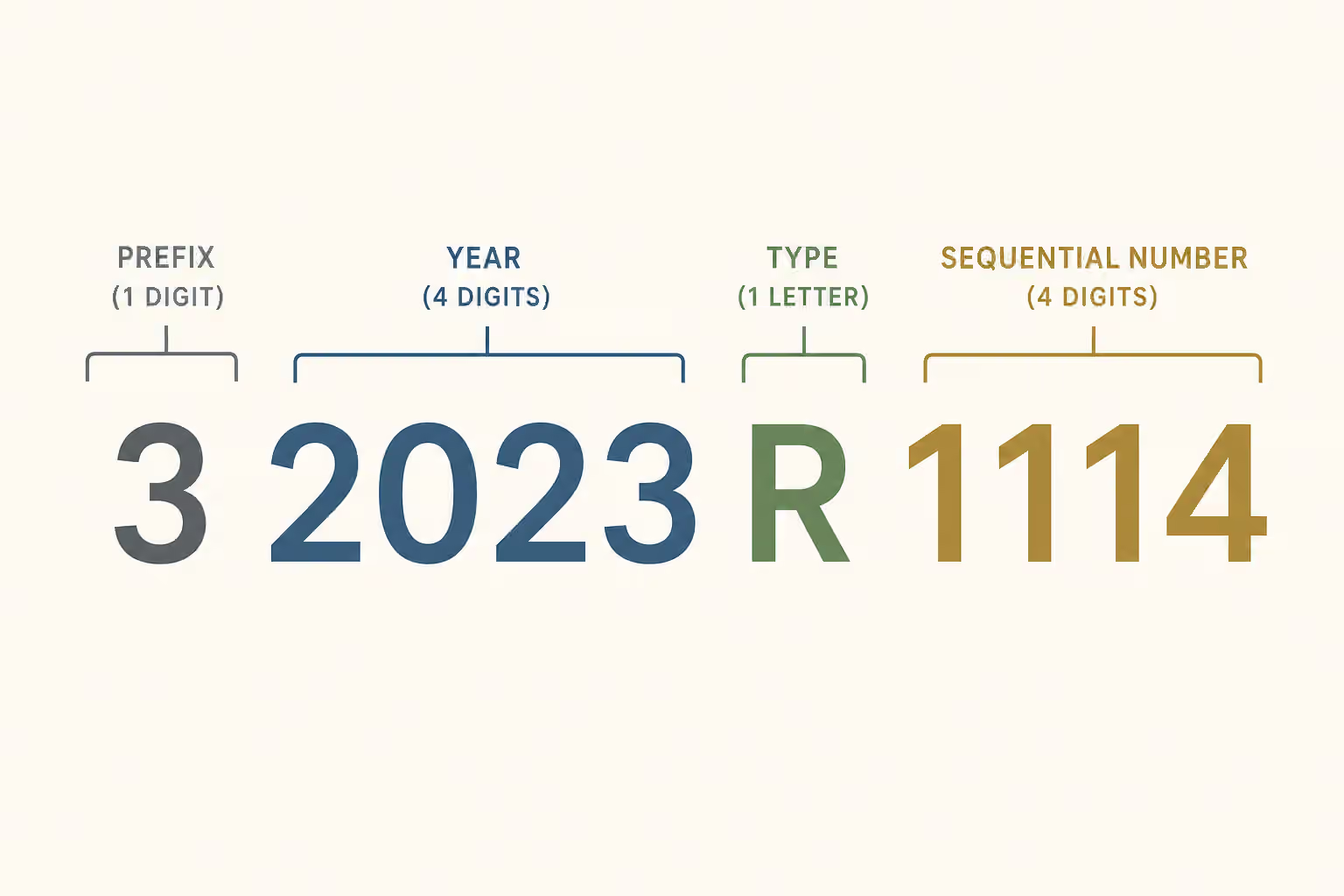
- The structure of a CELEX number encodes meaningful information. 32023R1114 breaks down as: sector 3 (secondary legislation), year 2023, type R (regulation), number 1114. Sector 3 covers regulations, directives, decisions, delegated acts, implementing acts, and technical standards. Type R is a regulation (directly applicable). Type L is a directive (requires national transposition). Type PC is a Commission proposal (useful for horizon scanning, not yet law).
- Framework regulations, delegated acts, implementing acts, and technical standards each have their own CELEX number. DORA is 32022R2554. An RTS adopted under DORA has a different CELEX number entirely. The full compliance picture for any given regulation is not one document but a set of documents, each with its own stable identifier. Tracking DORA compliance without tracking the secondary documents means tracking an incomplete picture of the actual obligation.
- CELEX numbers enable direct retrieval and verifiable citation. Entering a CELEX number into EUR-Lex returns the specific document immediately in all official languages with publication date, entry into force, and application date. A regulatory analysis that cites a CELEX number alongside a claim is verifiable. A citation by name alone requires knowing which version of the text is current and locating the specific article.
- A CELEX number identifies a document. It does not tell you whether it is in force, amended, or repealed. EUR-Lex tracks consolidations (updated versions incorporating amendments), but the consolidated version has a different identifier. CELEX numbers provide a reliable starting point and stable reference. The verification task (checking status, amendments, and later secondary instruments) remains separate.
Why a number matters more than a name
Most people who track EU regulation refer to legislation by name: MiCA, DORA, PSD3. Names are useful shorthand, but they are imprecise as identifiers. Names get abbreviated inconsistently. Regulations get amended and the amended version may circulate under a slightly different name. A search for "DORA regulation" returns a mixture of the framework regulation, the delegated acts, the regulatory technical standards, commentary, and summaries, with no reliable way to distinguish the authoritative source from everything else.
A CELEX number is different. It is a structured, unique identifier assigned to every document in the EU's legal system. It points to one specific document. It does not change when a document is summarised, cited, or discussed. It does not vary between databases. If you have a CELEX number, you can go directly to the authoritative text in EUR-Lex without ambiguity.
For anyone doing serious regulatory research, knowing how to read a CELEX number is a basic competency. This article explains the structure.
What EUR-Lex is and where CELEX numbers come from
EUR-Lex is the official database of EU law, maintained by the Publications Office of the European Union. It is the authoritative source for the full text of every EU regulation, directive, decision, delegated act, implementing act, and regulatory technical standard. Everything published in the Official Journal of the European Union is indexed in EUR-Lex and assigned a CELEX number.
The CELEX number is assigned at publication. It is stable: the same document always has the same CELEX number, regardless of where you encounter it. A regulatory intelligence system that anchors its alerts to CELEX IDs is pointing to this stable identifier, not to a headline or a secondary source.
The structure of a CELEX number
A CELEX number is made up of several components, each of which encodes specific information about the document. The format is not arbitrary. Once you understand what each component means, you can read a CELEX number the way you might read a filing reference or a document code.
A typical CELEX number looks like this: 32023R1114
Breaking this down:
The first digit: sector
The leading digit indicates the sector of EU law the document belongs to. For financial regulation purposes, the most important values are:
- 3 — secondary legislation (regulations, directives, decisions, delegated acts, implementing acts, technical standards). This is the sector most relevant to compliance work.
- 1 — Treaties (the foundational EU treaties, rarely referenced directly in day-to-day compliance monitoring).
- 4 — complementary legislation.
- 6 — case law from the Court of Justice.
Almost every regulatory document a compliance professional needs to track will begin with 3.
The year: four digits
The four digits following the sector number are the year of publication. In 32023R1114, the year is 2023. This is the year the document was published in the Official Journal, which may differ from the year the regulation was proposed, negotiated, or entered into application.
The document type: one or two letters
The letter or letters following the year indicate the type of legal instrument. The most common in financial regulation are:
- R — Regulation. Directly applicable across all member states without national implementation. 32023R1114 is a regulation: specifically, Regulation (EU) 2023/1114, which is MiCA.
- L — Directive. Requires national transposition. A directive CELEX number beginning with 32022L would be a directive published in 2022.
- D — Decision. Binding on those to whom it is addressed, often used for supervisory decisions or specific authorisation matters.
- PC — Proposal for a regulation or directive from the Commission. Useful for horizon scanning: a PC document is a legislative proposal, not yet law.
Delegated regulations and implementing regulations are both coded as R, since they take the legal form of a regulation. The CELEX number alone does not distinguish a delegated regulation from a framework regulation, but the full document title does.
The sequential number
The final digits are the sequential number assigned to the document within its year and type category. In 32023R1114, the number is 1114. This is simply the order in which the document was published, counted across all regulations in that year.
Reading examples
A few worked examples make this concrete.
32022R2554 is DORA. Sector 3 (secondary legislation), year 2022, type R (regulation), number 2554. Regulation (EU) 2022/2554 on digital operational resilience for the financial sector.
32023R1114 is MiCA. Sector 3, year 2023, type R, number 1114. Regulation (EU) 2023/1114 on markets in crypto-assets.
32019L2034 is the Investment Firms Directive (IFD). Sector 3, year 2019, type L (directive), number 2034.
32022L2556 is the DORA Directive, which amended several existing directives as part of the DORA package. Sector 3, year 2022, type L, number 2556. Note that the DORA legislative package includes both a regulation (32022R2554) and a directive (32022L2556). Tracking only one without the other gives an incomplete picture.
When you see a CELEX number cited in a regulatory intelligence source, you can now read it without opening the document. You know the year, the legal form, and the approximate place in the publication sequence for that year.
CELEX numbers for secondary legislation: technical standards and delegated acts
One of the more practically important applications of CELEX numbers is tracking the secondary legislation that sits beneath framework regulations. As explained in how EU financial regulation actually works, the operational compliance requirements for most regulated firms live not in the framework regulation but in the regulatory technical standards and delegated acts adopted under it.
These secondary instruments each have their own CELEX number, separate from the parent regulation. DORA is 32022R2554. An RTS adopted under DORA has a different CELEX number entirely. This means the full compliance picture for any given regulation is not one document but a set of documents, each with its own stable identifier, each retrievable directly in EUR-Lex.
For a compliance team monitoring obligations under DORA, for example, the relevant documents include not just 32022R2554 but a set of RTS and ITS adopted in 2024 and 2025, each with its own CELEX number, each containing operational requirements that the framework regulation does not specify. Tracking DORA compliance without tracking those secondary documents means tracking an incomplete picture of the actual obligation.
Using CELEX numbers in practice
The most direct use of a CELEX number is retrieval. Entering a CELEX number into the EUR-Lex search at eur-lex.europa.eu returns the specific document immediately, in all available languages, along with its publication date, entry into force date, and application date. No disambiguation, no sifting through search results, no risk of landing on an unofficial version.
A second use is citation. When a regulatory analysis cites a CELEX number alongside its claim, that citation is verifiable. Anyone reading the analysis can go directly to the source and check whether the claim accurately reflects what the legislation says. This is meaningfully different from a citation that references a regulation by name alone, where finding the relevant provision requires knowing which version of the text is current and locating the specific article.
This is why CELEX anchoring is central to any serious regulatory intelligence architecture. A system that surfaces regulatory developments without linking them to their CELEX-identified source in EUR-Lex is producing analysis that cannot be independently verified. For compliance purposes, unverifiable analysis is a liability, not an asset.
What CELEX numbers do not tell you
A CELEX number identifies a document. It does not tell you whether that document is currently in force, whether it has been amended, or whether it has been repealed and replaced. EUR-Lex tracks consolidations, which are updated versions of a regulation that incorporate subsequent amendments, but the consolidated version has a different identifier from the original.
For compliance monitoring, this means that finding a CELEX number is the beginning of the research task, not the end. You still need to check whether the document is in force, whether it has been amended, and whether there are more recent secondary instruments that have changed the operational requirements.
What the CELEX number gives you is a reliable starting point and a stable reference. In a regulatory landscape where the same requirement can be discussed under multiple names, in multiple summaries, across multiple secondary sources, that stability has real value.
For a broader explanation of how EU financial regulation is structured and where technical standards fit into the compliance picture, see how EU financial regulation actually works. For an overview of the EU financial regulatory landscape in 2026, see EU financial regulation in 2026: what you need to track.
Forseti monitors EU financial regulation continuously, anchoring every alert to a verified CELEX-identified official source. Start for free.
📋 Track EU financial regulation continuously
Forseti monitors EU financial regulation and delivers personalised alerts anchored to verified official sources.
14-day free trial. No credit card required.