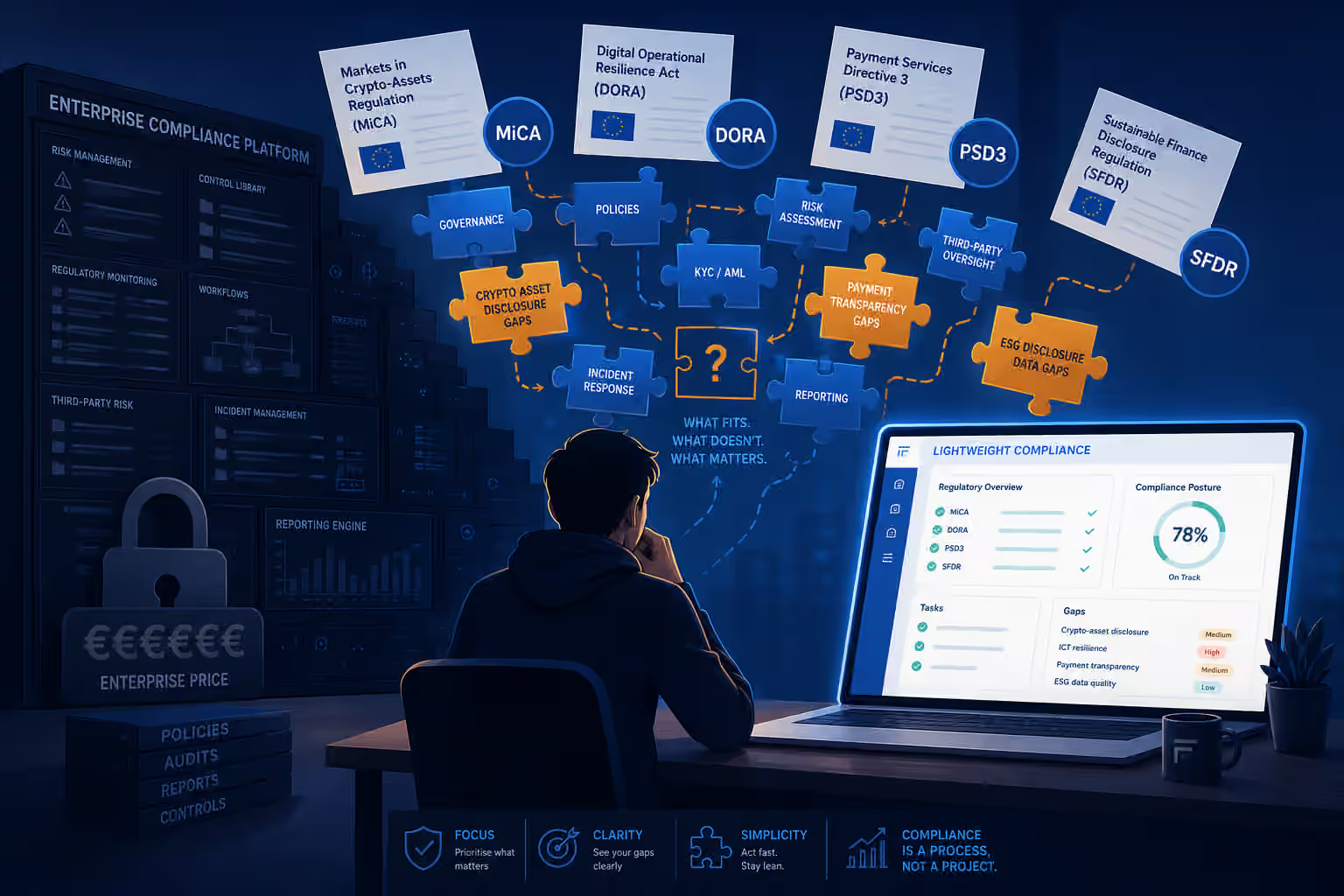
EU regulatory monitoring for fintech founders: what you need before you can afford a compliance team
Enterprise regulatory intelligence platforms are built for compliance teams most fintech founders do not have. Generic AI tools are fast but structurally unreliable for compliance decisions. This guide covers what EU regulatory monitoring actually looks like for a pre-Series-A fintech navigating MiCA, PSD3, or DORA scope questions.
This article is for informational purposes only and does not constitute legal advice. Consult a qualified legal professional for advice specific to your situation.
- Enterprise regulatory intelligence platforms are built for large financial institutions with multi-person compliance teams, multi-jurisdiction obligations, and enterprise budgets. They are priced and implemented accordingly. For a pre-Series-A fintech with EU-only obligations and a one-to-three person compliance function, the cost-benefit calculation does not work. Multi-jurisdiction coverage, analyst-curated workflow tasks, and prudential reporting integration are features designed for a different problem.
- Generic AI tools (ChatGPT, Gemini, Perplexity) are fast and accessible but structurally unreliable for compliance decisions. Common failure modes include: describing authorisation requirements from prior versions of a regulation, mischaracterising scope and exemptions, presenting proposal text as adopted law, and blending requirements across related regulations. The output is fluent and confident regardless of accuracy. A tool cannot tell you which specific CELEX-identified document a claim came from, when it was published, or whether the claim reflects regulation text or interpretation layered on top of it.
- EUR-Lex is free, authoritative, and the right starting point for reading the actual text of any EU regulation. Every regulation, directive, implementing act, and delegated act is on EUR-Lex with a unique CELEX identifier and full text in all official languages. EUR-Lex does not have alert infrastructure for new implementing acts, personalisation to your firm's profile, or a plain-language query interface. It is an archive, not a monitoring system.
- A workable monitoring approach for fintech founders combines four layers: source-anchored regulatory intelligence for adopted law (covering MiCA, DORA, SFDR, the AI Act, and PSD3 once adopted), direct ESMA and EBA publication monitoring for technical standards and Q&As, NCA engagement for jurisdiction-specific authorisation requirements, and legal advice for scope and interpretation questions. The combination is cheaper than enterprise platforms and more reliable than generic AI.
- The frameworks most commonly relevant to fintech founders are MiCA (crypto-assets), PSD3 and the Payment Services Regulation (payments), DORA (ICT resilience and third-party risk), SFDR (investment products), and the AI Act (high-risk AI use cases). These overlap in ways that are not always obvious. A fintech providing payment services and crypto-asset services navigates PSD3 and MiCA simultaneously. A firm providing AI-powered investment analysis navigates SFDR, MiFID II, and the AI Act at the same time.
The compliance problem fintech founders actually have
Enterprise compliance platforms are designed for a specific buyer: a large financial institution with a multi-person compliance team, a multi-year software budget, and regulatory obligations that span multiple jurisdictions and regulatory frameworks simultaneously. That buyer exists and those platforms serve them well.
A fintech founder building a payment service, a crypto-asset exchange, or an alternative investment platform has a structurally different problem. They need to understand what EU financial regulation requires of their specific business model. They need to know when new obligations or implementing measures arrive that affect their activities. And they need to do this without a dedicated compliance team, without an enterprise software budget, and without the six-month implementation timeline that enterprise platforms require before they are useful.
Most of the content written about EU regulatory compliance is written for the first buyer, not the second. This article is written for the second.
What EU financial regulation you are most likely to encounter
The frameworks most commonly relevant to fintech founders building EU-facing products:
MiCA — if you are building anything involving crypto-assets, the Markets in Crypto-Assets Regulation (Regulation (EU) 2023/1114, CELEX: 32023R1114) applies. Full application began 30 December 2024. If you are operating as a crypto-asset service provider, you need authorisation from a national competent authority. If you are issuing an asset-referenced token or e-money token, separate issuance requirements apply. The authorisation process involves documentation requirements specified in ESMA technical standards that most generic summaries of MiCA do not cover in detail.
PSD3 and the Payment Services Regulation — if you are building a payment service, the third Payment Services Directive and the companion Payment Services Regulation are the incoming framework replacing PSD2. PSD3 had not reached final adoption as of mid-2026 but the trilogue process was progressing. Understanding where PSD3 will land on open banking access, strong customer authentication, and fraud liability matters for product decisions being made now.
DORA — if your fintech provides ICT services to financial entities, or if you are a financial entity yourself, the Digital Operational Resilience Act (Regulation (EU) 2022/2554, CELEX: 32022R2554) has applied since January 2025. The ICT third-party risk provisions, in particular, affect fintech providers whose services are used by regulated financial firms. Understanding whether your firm is in DORA's scope, either as a financial entity or as a critical third-party provider, is a foundational question. The DORA compliance checklist for financial entities covers all five pillars and what demonstrable compliance looks like in practice.
SFDR — if you are building an investment product with a sustainability angle, the Sustainable Finance Disclosure Regulation (Regulation (EU) 2019/2088) determines how that product must be classified and what must be disclosed about it. The Article 8 and Article 9 classifications carry specific documentation and disclosure obligations that affect marketing and investor communications.
The AI Act — if your product uses AI in ways that affect credit decisions, fraud detection, or customer scoring, the EU AI Act classifies those use cases as high-risk and imposes specific obligations. High-risk AI system requirements began applying in August 2026.
These frameworks overlap in ways that are not always obvious at the outset. A fintech that provides both payment services and crypto-asset services may be navigating PSD3 and MiCA simultaneously. A firm providing AI-powered investment analysis may be navigating SFDR, MiFID II, and the AI Act at the same time.
What enterprise platforms offer and why they are usually the wrong choice
Enterprise regulatory intelligence platforms (Wolters Kluwer FRR, Corlytics, Thomson Reuters Regulatory Intelligence) provide comprehensive multi-jurisdiction regulatory monitoring with workflow management, analyst curation, and integration with compliance management systems.
They are also priced for compliance teams at major financial institutions. Multi-year enterprise contracts, specialist implementation partners, and per-seat pricing calibrated for large teams make the economics inaccessible for a pre-Series-A fintech. Even at Series B and beyond, the cost-benefit calculation for a platform designed for a twenty-person compliance team at a bank does not work for a three-person compliance function at a growth-stage fintech.
The features that justify enterprise pricing are also features a fintech founder does not need. Multi-jurisdiction coverage across EU, UK, US, and APAC is valuable for a global bank and irrelevant for a fintech with EU-only obligations. Analyst-curated workflow tasks designed for large teams are useful when you have a team to act on them and unnecessary when you need to understand the regulation directly yourself. The bundled prudential reporting infrastructure is valuable for banks managing capital calculations and not relevant for a fintech that is not subject to CRR3.
The conclusion is not that these platforms are bad. It is that they are not designed for this problem.
What generic AI tools offer and why they are structurally unreliable
Generic AI tools (ChatGPT, Gemini, Perplexity, Claude used as a general-purpose research tool) are the natural alternative for a founder who cannot justify enterprise platform costs. They are fast, accessible, and produce clear, readable summaries of complex regulatory frameworks. They appear to know a great deal about MiCA, DORA, and SFDR.
The structural problem is that they do not know when they are wrong. Their outputs are generated from training data that was assembled at a point in the past and has not been updated since. For EU financial regulation, which has been in active development across multiple frameworks simultaneously, the gap between training data vintage and current regulatory state can be material.
The specific failures that recur for fintech founders using generic AI tools for regulatory research:
Describing authorisation requirements from a prior version of the regulation. MiCA's technical standards for CASP authorisation were finalised progressively through 2024. A tool trained before those standards were published will describe the framework regulation's general requirements without the operational specifics that actually determine whether an authorisation application is complete.
Mischaracterising scope and exemptions. Whether your firm needs a full CASP authorisation or falls under an exemption depends on details of your business model, the types of crypto-assets you handle, and the services you provide. Generic AI tools regularly mischaracterise these scope provisions, applying exemptions too broadly or too narrowly.
Presenting proposal text as adopted law. PSD3 was still in trilogue as of mid-2026. A tool with training data from a period when PSD3 was further advanced in the legislative process may describe its provisions as current obligations when they have not yet been adopted.
Blending requirements across related regulations. MiCA and MiFID II overlap for firms offering services across both crypto-assets and traditional financial instruments. Generic AI tools regularly blend the requirements of both regulations in ways that are not accurate for either.
The consequence for a fintech founder is not just wasted preparation effort. It is compliance decisions (product architecture, licensing strategy, authorisation application preparation) made on the basis of regulatory information that may be materially wrong.
The three-test framework for evaluating any regulatory intelligence tool is developed in full in why generic AI tools are unreliable for regulatory compliance research. The short version: if a tool cannot tell you which specific CELEX-identified document a claim came from, when that document was published, and whether the claim reflects the regulation text or an interpretation layered on top of it, the tool is not fit for compliance-grade regulatory research.
What EUR-Lex direct provides
EUR-Lex is free, authoritative, and the primary source for all EU legal instruments. For a fintech founder who wants to read the actual text of a regulation, EUR-Lex is the right starting point. Every regulation, directive, implementing act, and delegated act published in the Official Journal is on EUR-Lex with a unique CELEX identifier and a full text in all official EU languages.
The limitations of EUR-Lex as a monitoring tool are practical rather than substantive. EUR-Lex does not have an alert infrastructure that tells you when a new implementing act relevant to your business has been published. It does not have a personalisation layer that matches new publications to your firm's regulatory profile. It does not have a query interface that lets you ask a plain-language question and receive an answer sourced from the current text. It is an archive, not a monitoring system.
For a fintech founder who knows exactly what they are looking for and has the time to search EUR-Lex manually, it is the most reliable free source available. For a founder who needs to stay current across multiple regulatory files simultaneously without spending hours per week on manual monitoring, EUR-Lex alone is not sufficient.
The practical monitoring approach for fintech founders
A workable EU regulatory monitoring approach for a fintech founder who cannot justify enterprise platform costs:
Source-anchored regulatory intelligence for the adopted law layer. Forseti monitors adopted EU financial regulation continuously via EUR-Lex, matches alerts to your firm's sector profile, and provides a query interface where plain-language compliance questions receive answers sourced from the current official text with CELEX citations. For the regulations most relevant to fintech founders (MiCA, DORA, PSD3 once adopted, SFDR, the AI Act) this provides continuously updated coverage without enterprise pricing or implementation burden.
Direct ESMA and EBA publication monitoring for technical standards. ESMA and EBA publish technical standards, Q&A documents, and supervisory guidance on their own websites, not on EUR-Lex. Adding ESMA and EBA publication alerts to your monitoring approach covers the supervisory interpretation layer that EUR-Lex-anchored tools do not capture. Both authorities publish RSS feeds that are worth subscribing to for the regulatory files relevant to your firm.
NCA engagement for jurisdiction-specific requirements. If you are seeking CASP authorisation under MiCA or payment institution authorisation under PSD3, the NCA of the member state you are seeking authorisation from is the primary source for jurisdiction-specific requirements, documentation expectations, and process timelines. NCAs publish this information in varying levels of detail. Some have extensive online guidance; others require direct contact.
Legal advice for scope and interpretation questions. No monitoring tool replaces the legal judgment required to assess whether your specific business model falls within the scope of a regulation, whether an exemption applies, or how to structure a product to meet a specific regulatory requirement. The monitoring layer informs those questions by ensuring your legal advisor is working from the current text. It does not answer them.
The combination of source-anchored regulatory intelligence, direct ESA monitoring, NCA engagement, and periodic legal advice is substantially cheaper than an enterprise platform, substantially more reliable than generic AI tools, and sufficient for most fintech founders to stay current with their EU regulatory obligations.
Forseti monitors EU financial regulation continuously, delivering personalised alerts and source-anchored answers matched to your firm's regulatory profile, at a price point designed for the compliance function you actually have. Start for free.
📋 Track EU financial regulation continuously
Forseti monitors EU financial regulation and delivers personalised alerts anchored to verified official sources.
14-day free trial. No credit card required.