How does Forseti handle regulatory change? EUR-Lex ingestion explained for compliance professionals
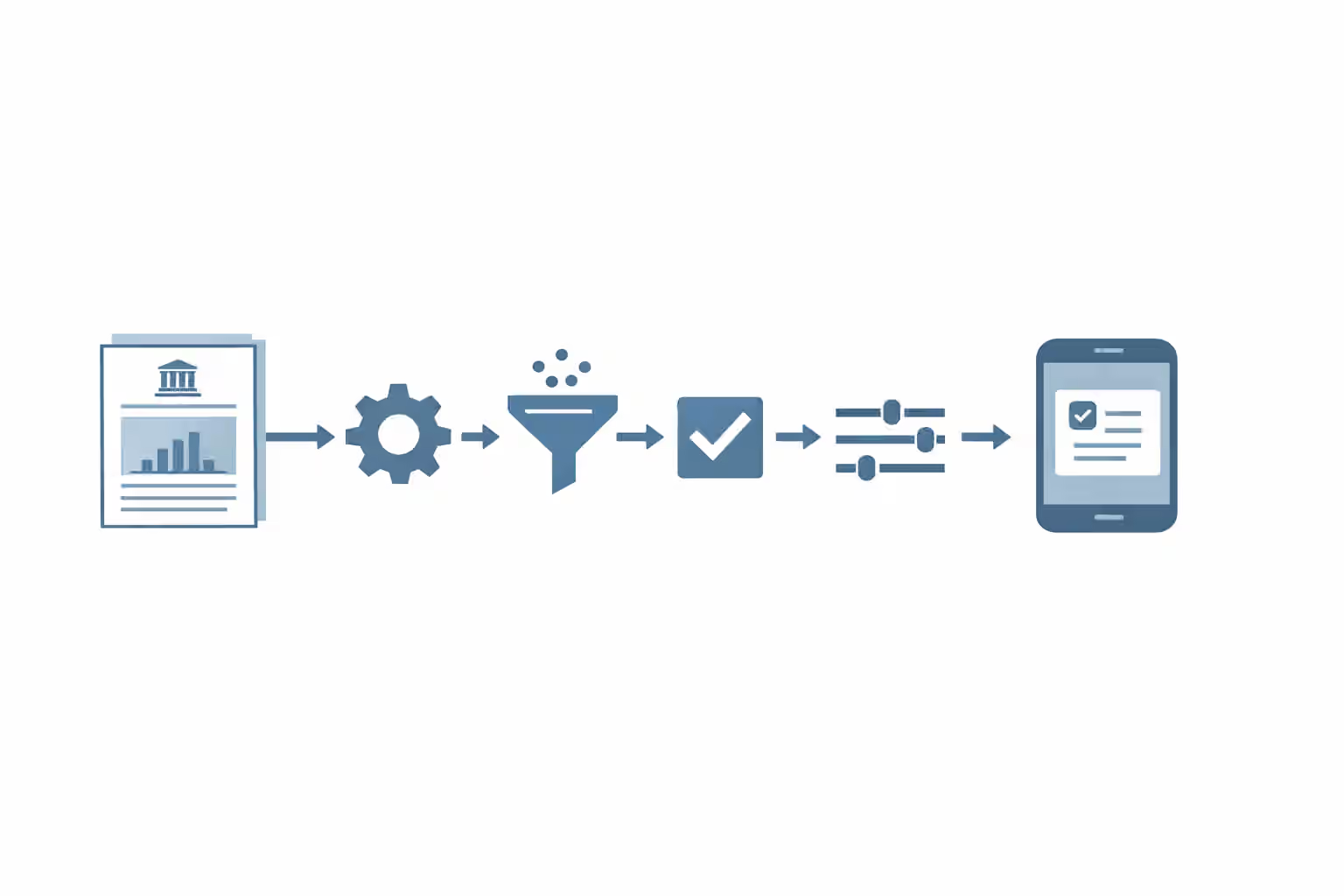
Forseti monitors EU financial regulation continuously via EUR-Lex, delivering personalised alerts anchored to verified official sources. This article explains how that works in plain language: what gets ingested, how it is matched to your firm, what happens when you ask a question, and what happens when the corpus has a gap.
This article is for informational purposes only and does not constitute legal advice. Consult a qualified legal professional for advice specific to your situation.
- How a regulatory intelligence platform ingests matters as much as what it covers: broad coverage from a corpus assembled months ago is a reference library with an uncertain publication date, not a monitoring tool. Forseti runs automated ingestion daily against EUR-Lex and the EBA, ESMA, and EIOPA publication pages, because EU financial regulation does not publish on a schedule and a system that updates weekly or monthly will miss developments that land between updates.
- Adopted law and pre-legislative content are kept strictly separate by design: EUR-Lex is the authoritative record of binding regulation, while Commission proposals and ESA guidelines, which operate on a comply-or-explain basis, are surfaced in clearly labelled, distinct categories. Mixing these creates a specific compliance risk, preparing for obligations that don't yet exist, or failing to distinguish a binding requirement from a supervisory interpretation a firm could choose not to follow with proper documentation.
- Every alert and query answer is synthesised only from retrieved official source text and cited to a CELEX identifier and article number, never generated from training data or a general characterisation of the regulatory landscape. This lets a compliance professional verify the summary against the original text and document the basis for any decision made in response.
- Alerts are personalised to a firm's declared sector profile, so a banking and operational resilience firm doesn't receive MiCA CASP alerts and a crypto assets firm doesn't receive Solvency II alerts, but the system stops at filtering relevance. Determining how a specific instrument applies to a firm's exact authorisation type and business model remains the compliance professional's judgment call, not the system's.
- When the corpus has a gap, the system says so rather than producing a plausible but unverifiable answer, and in borderline cases it flags a lower-confidence response drawing on adjacent material rather than the exact provision asked about. This is the central difference from generative AI tools, which answer confidently regardless of whether they actually have the relevant information.
Why how a system ingests matters as much as what it ingests
Compliance professionals evaluating regulatory intelligence tools tend to focus on coverage: which regulations does the platform monitor, and does it cover the jurisdictions I care about? These are reasonable questions. But they are secondary to a more fundamental one: how does the platform know what the regulation currently says, and how quickly does it know when that changes?
A platform that covers EU financial regulation broadly but draws on a corpus assembled months ago is not a monitoring tool. It is a reference library with an uncertain publication date. A platform that updates continuously but cannot trace its outputs to the specific source documents it retrieved is not source-anchored in any meaningful sense. For a treatment of why that distinction matters, see what does it mean for a regulatory intelligence tool to be source-anchored?.
This article explains how Forseti approaches the ingestion problem in plain language: what it monitors, where it monitors from, how it connects new regulatory developments to the firms they affect, and how it handles the cases where the official corpus has not yet published the content a query needs.
The source: EUR-Lex and the European Supervisory Authorities
Forseti draws on two categories of official source, which correspond to two different types of regulatory content and are kept strictly separate.
The first is EUR-Lex, the official database of EU law maintained by the Publications Office of the European Union. EUR-Lex contains every regulation, directive, delegated act, implementing act, and regulatory technical standard published in the Official Journal of the European Union. This is the authoritative record of adopted EU law. When a regulation is in force, EUR-Lex is where it lives.
The second is the published output of the European Supervisory Authorities: the European Banking Authority (EBA), the European Securities and Markets Authority (ESMA), and the European Insurance and Occupational Pensions Authority (EIOPA). These bodies publish guidelines, opinions, recommendations, and Q&A clarifications that interpret how adopted regulations apply in practice. They do not have the same legal status as adopted regulations, but they operate on a comply-or-explain basis that makes them practically significant for most regulated firms. For an explanation of what EBA, ESMA, and EIOPA do and how their output relates to adopted legislation, see ESMA, EBA, and EIOPA: who does what in EU financial supervision.
Forseti ingests from both sources. The outputs are clearly labelled by their legal status and kept strictly separate. An alert about an adopted regulation and an alert about an EBA guideline are presented differently, because they have different legal characters and require different responses from a compliance professional.
What "monitoring continuously" actually means
Forseti runs automated ingestion daily. Each run checks the EUR-Lex official record and the EBA, ESMA, and EIOPA publication pages for new content that falls within the scope of EU financial regulation.
For EUR-Lex, this means querying the official document database for newly published instruments: regulations, directives, implementing acts, delegated acts, and regulatory technical standards. When a new document appears, Forseti retrieves the full text directly from the official EUR-Lex record, assigns the CELEX identifier that EUR-Lex has given it, and begins the process of making it available for alerts and queries.
For the supervisory authorities, Forseti checks the EBA, ESMA, and EIOPA publication pages for new guidelines, opinions, and recommendations. These bodies publish on irregular schedules across multiple regulatory dossiers simultaneously. Manual monitoring of all three at any useful frequency is a significant workload. Forseti handles that monitoring programmatically and surfaces new publications as they appear.
The frequency matters because EU financial regulation does not publish on a schedule. Regulatory technical standards are finalised when they are finalised. Supervisory guidance is issued when a question becomes pressing enough to warrant it. An application deadline can arrive alongside implementing guidance that has only just been published. A monitoring system that updates weekly or monthly will miss the period between updates, and that period can contain material developments.
How new content becomes an alert
When new regulatory content is ingested, Forseti does several things before it becomes an alert.
The full text is processed to identify the regulatory sectors the document is relevant to. EU financial regulation touches a range of sectors, including banking, capital markets, crypto assets, insurance, investment, operational resilience, payments, prudential requirements, and sustainability. A document that addresses ICT risk management requirements is relevant to firms monitoring operational resilience. A document about CASP authorisation is relevant to firms in the crypto assets sector. The sector tagging determines which firm profiles receive the alert.
Forseti then generates a plain-language summary of what the document requires and what its likely implications are for firms in the relevant sectors. This synthesis is produced from the retrieved document text. It is not produced from training data or from a general characterisation of the regulatory landscape. The AI layer operates on the specific document that has been retrieved, and the summary is constrained to what that document says.
Every alert includes the CELEX identifier for the source document and a link to the source text. The compliance professional receiving the alert can verify the summary against the original, read the specific provisions referenced, and document the basis for any decision they make in response.
How alerts are personalised to your firm
Not every regulatory development is relevant to every firm. Forseti matches incoming regulatory content to firm profiles based on the sectors a firm has identified as relevant to its business.
A firm that has identified its profile as covering banking and operational resilience receives alerts for instruments relevant to those sectors. It does not receive alerts about CASP authorisation requirements under MiCA, because those requirements are not within its regulatory perimeter. A firm with a crypto assets profile receives MiCA-related alerts but may not receive alerts about Solvency II implementing acts directed at insurance undertakings.
The profile also determines relevance at a more granular level. EU financial regulation applies differently to different types of firms within the same broad sector. A payment institution, an electronic money institution, and a credit institution may all be broadly characterised as part of the payments or banking sector, but the specific obligations they face under PSD3, DORA, and CRR3 differ in important ways. The personalisation layer uses the sector profile to filter, but the compliance professional remains responsible for determining how a given instrument applies to their specific authorisation type and business model.
This is the appropriate division of responsibility between a regulatory intelligence system and the professionals using it. Forseti handles the monitoring volume: tracking a large and fast-moving regulatory corpus, identifying which developments fall within a firm's sector perimeter, and surfacing them with enough lead time to be useful. The compliance professional handles the judgment: whether a development applies to their specific circumstances and what action it warrants.
Adopted law and legislative proposals are kept strictly separate
One of the more important design choices in how Forseti handles regulatory change is the strict separation between adopted law and pre-legislative content.
Adopted regulations are binding on firms in scope from their application date. Adopted law is the foundation on which everything else sits. When you query Forseti, you are by default querying the corpus of adopted EU financial law.
Commission proposals are a different category. A proposal is a Commission draft that has been published but has not yet passed through the EU legislative process. It may be amended significantly in trilogue. It may be withdrawn. It carries no current compliance obligation. Forseti makes Commission proposals available as a separate, clearly labelled section so that compliance professionals can track what is coming without conflating it with what is currently binding.
The same separation applies to supervisory guidance. EBA guidelines, ESMA opinions, and EIOPA recommendations are not adopted law. They operate on a comply-or-explain basis. They are surfaced clearly as supervisory guidance rather than binding regulation, because the compliance response to a new EBA guideline is different from the compliance response to a new adopted delegated regulation, even if the substantive content covers similar ground.
Mixing these categories without labelling them creates a specific kind of compliance risk: firms may prepare for obligations that do not yet exist, or fail to distinguish between a binding requirement and a supervisory interpretation they could, in principle, choose not to follow with appropriate documentation. Forseti's architecture prevents that confusion by design. For a broader treatment of the EU legislative pipeline and how these categories relate to each other, see what is regulatory horizon scanning and why compliance teams need it.
What happens when you ask a question
The alert layer tells you that something has changed. The query layer allows you to interrogate what it means for your specific situation.
When a compliance professional asks Forseti a question, the system searches the official source corpus for the provisions most relevant to that question. It uses the firm's sector profile to prioritise results from within the firm's regulatory perimeter. It then synthesises an answer from the retrieved provisions and presents that answer alongside the specific CELEX identifiers and article numbers it is drawing on.
The answer is produced from what has been retrieved, not from a general understanding of EU financial regulation. If the corpus contains the relevant provision, the answer will cite it directly. If the corpus does not contain it, the system does not produce a plausible approximation. It tells you there is a gap.
The query layer is designed for the specific, article-level questions that monitoring platforms are typically not built to answer. What does Article 30 of DORA require for ICT third-party risk management? How does the SFDR definition of sustainable investment apply to a fund with an Article 8 classification? What are the own funds requirements under CRR3 for a firm of our type? These are the questions that arise after an alert has been received and the compliance work begins. The query layer is where those questions get answered, with the source in view.
What happens when the corpus has a gap
No regulatory corpus is complete at every moment. Regulatory technical standards are sometimes adopted and published with limited notice. Implementing acts appear when the Commission adopts them. Some documents are published and take time to be indexed and fully available in the official record.
When a query touches on a provision that is not yet in the Forseti corpus, the system does not fabricate an answer. It identifies the gap and tells you clearly. In some cases, where a query is close to corpus content but not fully covered, Forseti will provide a lower-confidence response with a clear indication that the answer is drawing on adjacent material rather than the specific provision being asked about. The status of the answer is always visible.
This is a meaningful difference from generative AI tools, which produce confident answers regardless of whether they have the relevant information. A system that tells you it has a gap is more useful for compliance purposes than one that fills the gap with a plausible but unverifiable response. For a full treatment of why generative AI tools fail this test, see why generic AI tools are unreliable for regulatory compliance research.
When a gap is filled by a new publication, users who queried the relevant topic are notified. The regulatory development they were asking about has arrived in the corpus, and they can now query it directly.
What this means for a compliance professional in practice
The practical effect of this architecture is that Forseti handles the monitoring burden that makes regulatory intelligence difficult at scale: continuous coverage of a large and fast-moving regulatory corpus, relevance filtering matched to your sector profile, plain-language synthesis with source citations, and a query interface for the specific questions that arise from regulatory change.
The compliance professional's role is the one that requires human judgment: assessing how a given development applies to the firm's specific circumstances, deciding what action is warranted, documenting the basis for that decision, and advising senior management on the compliance implications.
The division is not incidental. It reflects what automated systems can do reliably and what they cannot. Monitoring volume, retrieving official source text, generating summaries calibrated to a sector profile, and answering specific article-level questions with citation are tasks where a well-built system outperforms manual research in speed and consistency. Assessing materiality for a specific firm structure, weighing competing interpretations, and advising on risk appetite are tasks where professional judgment is not substitutable.
A system that tried to do the second category of work would be overstepping what any automated system can do reliably in a compliance context. Forseti is designed to do the first category as well as it can be done, so that the compliance professional can focus on the second.
Forseti monitors EU financial regulation continuously, delivering personalised alerts and source-anchored answers cited to specific CELEX identifiers and article numbers. Start for free.
See also: What does it mean for a regulatory intelligence tool to be source-anchored? and what is regulatory horizon scanning and why compliance teams need it.
📋 Track EU financial regulation continuously
Forseti monitors EU financial regulation and delivers personalised alerts anchored to verified official sources.
14-day free trial. No credit card required.