How to respond to a CSRD or CSDDD supplier questionnaire from an EU buyer
If an EU buyer has sent you a sustainability questionnaire, you have a specific, time-limited problem. This article explains what the questionnaire is asking for, why, what happens if you cannot answer it, and how to respond in a way that satisfies your buyer's regulatory obligations.
This article is for informational purposes only and does not constitute legal advice. Consult a qualified legal professional for advice specific to your situation.
What the questionnaire actually is
A sustainability questionnaire from an EU buyer is not a market research exercise or a corporate responsibility initiative. It is a data collection instrument that your EU buyer needs to complete its own legal obligations.
Large EU companies subject to the Corporate Sustainability Reporting Directive must report on their sustainability impacts across their entire value chain, including the facilities and operations of their suppliers. The European Sustainability Reporting Standards require disclosures on greenhouse gas emissions, workforce conditions, environmental management, and other topics that an EU company cannot report on without data from the businesses it buys from.
Large EU companies subject to the Corporate Sustainability Due Diligence Directive must identify, assess, and address actual and potential adverse human rights and environmental impacts in their supply chains. They cannot do this without information about how their suppliers operate.
The questionnaire arriving in your inbox is how your EU buyer collects both categories of information. Understanding that it is regulatory in origin, not discretionary, changes how you should approach responding to it.
Why the timing is urgent
EU buyers are not running sustainability questionnaire programmes on a relaxed timeline. CSRD wave one companies, those with more than 500 employees that are listed or meet certain size thresholds, began reporting on the 2024 financial year. Wave two companies, large unlisted EU companies above the 250 employee and EUR 50 million turnover thresholds, begin reporting on the 2025 financial year. Their data collection cycles run parallel to their financial year, and supplier data is needed before the reporting period closes and assurance begins.
A questionnaire sent to you in mid-year typically has a deadline because your buyer’s internal reporting cycle has one. Missing that deadline does not simply mean a late return. It may mean your buyer has a gap in a material disclosure, which creates an audit qualification risk. Buyers managing large supplier networks will not hold their reporting schedule for a single supplier. An unresponded questionnaire, or a response so incomplete it cannot be used, is treated as a data gap in the report, which has direct consequences for how that report is assured.
Reading the questionnaire before you answer it
Before completing anything, read the questionnaire in full and identify what category of information is being requested. Most EU buyer sustainability questionnaires draw on a combination of CSRD data requirements and CSDDD due diligence requirements, and the type of information being requested in each section affects how you should approach it.
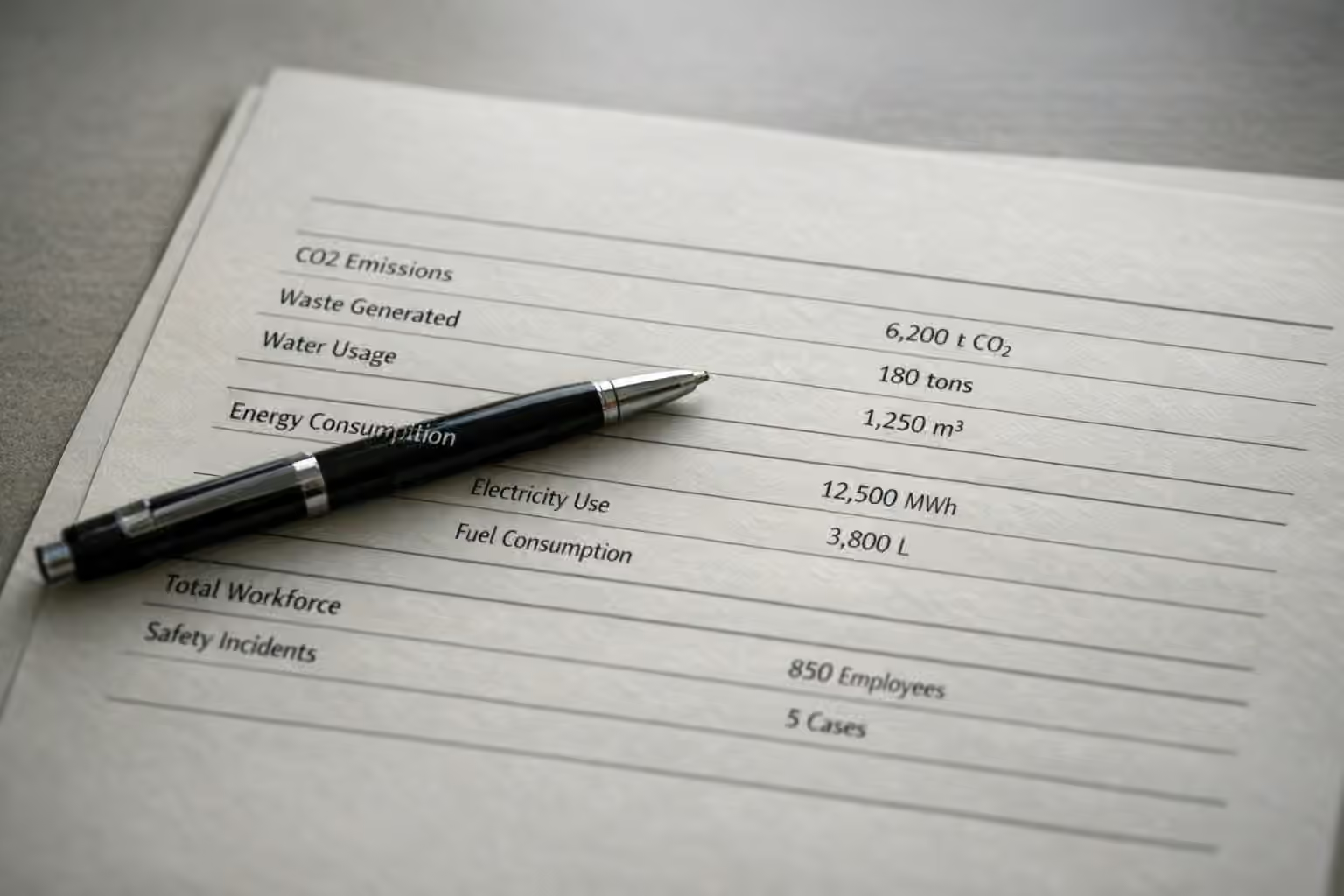
Quantitative data requests ask for specific figures: energy consumption in MWh, greenhouse gas emissions in tonnes of CO2 equivalent, number of employees, lost time injury frequency rate, waste generated in tonnes. These require you to either have the figures from your own operational records or to state clearly that you do not track them. Estimating without disclosing that you are estimating is not a sound approach. Your buyer’s assurance auditor will probe the credibility of the data, and figures that cannot be substantiated will raise questions about everything else you submitted.
Policy and management system questions ask whether you have specific policies, certifications, or management systems: an environmental policy, an ISO 14001 certification, a code of conduct for your own suppliers, a grievance mechanism. These are yes or no questions with a supporting documentation requirement. If you have the policy, provide it. If you do not, say so rather than providing a document that does not actually meet the standard being asked about.
Practice and process questions ask what you actually do: how you manage chemical waste, how you handle worker grievances, how you select and monitor your own sub-suppliers. These require descriptive answers based on actual operational practice. Generic answers that could apply to any manufacturer are not useful to your buyer’s compliance team and will often prompt a follow-up request for more specific information.
Certification and audit evidence requests ask for current third-party audit reports or certificates. If you have SMETA, SA8000, or equivalent audit results, attach them. If your audit has expired, note when it was last conducted and whether a renewal is in progress. If you have no third-party audit, say so rather than substituting an internal assessment.
The sections that require the most preparation
Most questionnaires contain sections that are straightforward to complete if you have the underlying data, and sections that require more careful preparation. The sections that consistently require the most effort from suppliers who have not previously tracked this information are the following.
Greenhouse gas emissions. CSRD requires EU companies to report Scope 3 emissions, which includes the manufacturing emissions embedded in the goods they purchase. Your buyer needs your Scope 1 and Scope 2 emissions, expressed as tonnes of CO2 equivalent, for the period covered by their reporting year. If you have not previously calculated these figures, a full GHG inventory requires activity data for energy consumption, fuel use, and process emissions across your operations, and the application of the relevant emission factors. This takes time to do properly. For a first submission, buyers will often accept figures calculated using sector-average emission factors or the GHG Protocol’s tools, provided the methodology is disclosed. Do not submit a figure without explaining how it was calculated.
Living wage information. ESRS S2, covering workers in the value chain, requires EU companies to report on whether the workers in their supply chain are paid at or above living wage benchmarks. Your buyer may ask whether your wages meet the local living wage, and if not, by what percentage they fall short. The living wage benchmark for your location is typically published by the Anker Research Institute or a regional equivalent. If you do not know what the benchmark is for your location, look it up before answering. If your wages are below the benchmark, say so honestly. Buyers generally are not expecting perfection at this stage of CSRD implementation. They are expecting honest disclosure that allows them to report the actual situation.
Sub-supplier and supply chain questions. CSDDD requires EU companies to extend their due diligence to their indirect business partners where risk assessments indicate it is necessary. Your buyer may ask you to disclose your significant sub-suppliers, describe how you select them, and explain what sustainability requirements you impose on them. If you have not previously thought about this, the practical starting point is identifying your most significant input suppliers and being able to describe what, if anything, you require from them. A buyer asking this question is not expecting a fully developed tier-two due diligence programme from every supplier. They are trying to understand the risk landscape of their own extended supply chain.
Grievance and complaints mechanisms. CSDDD requires companies to establish or participate in grievance mechanisms accessible to workers and other affected parties. Your buyer may ask whether your workers have access to a mechanism for raising concerns, what that mechanism is, and whether it is accessible to migrant and temporary workers as well as permanent employees. If you have a mechanism, describe it concretely: how workers access it, whether it is confidential, and what happens when a concern is raised. If you do not have a formal mechanism, describe what workers actually do when they have a concern and whether there is a pattern of concerns being raised and addressed.
What to do when you do not have the information being requested
This is the most common practical problem, and it requires a direct approach rather than avoidance.
Where you do not have data being requested, the right response is a clear statement of what you currently track and what you do not, accompanied by a timeline for when you expect to be able to provide the missing data. “We do not currently calculate our GHG emissions but have engaged an external consultant to conduct a baseline inventory for the current financial year, which we expect to have available by Q4” is a usable response for a buyer’s compliance team. It is a gap in their data, but a documented one with a resolution timeline.
A buyer receiving that response can record it accurately in their CSRD report, noting that data for certain suppliers was not yet available and the steps being taken to address this. A buyer receiving a blank field, or a non-answer disguised as an answer, cannot.
What you should not do is submit fabricated or significantly estimated figures as if they were measured data. CSRD assurance requirements are tightening over time. Figures submitted in year one will be used as baselines against which year two figures are assessed. Data that cannot be substantiated will be flagged in the assurance process, which creates a problem for both you and your buyer.
The covering note
Whatever you submit, include a brief covering note that explains the basis for your responses. This is not a formality. It is the document that allows your buyer’s sustainability team to assess the quality of your submission and decide what follow-up, if any, is needed.
The covering note should identify who completed the questionnaire and their role, state the period the data covers, note any sections where data was estimated rather than measured and the methodology used, identify any sections that could not be completed and the reason, and provide contact details for follow-up questions.
A well-structured covering note signals to your buyer that the submission was completed by someone who understood what was being asked and why, and that the data can be relied on within the limitations disclosed. That is a meaningful form of commercial differentiation at a time when many suppliers are submitting incomplete or unreliable returns.
What happens after you submit
Your buyer’s sustainability team will review the submission and flag any sections that are incomplete, inconsistent, or require clarification. Expect follow-up questions. A first submission from a supplier that does not have a pre-existing sustainability reporting programme will almost always generate some follow-up, and receiving follow-up questions is not a sign that the submission failed.
Where your submission identifies practices or conditions that fall below the standards your buyer is required to address under CSDDD, you should expect a request for a corrective action plan rather than immediate commercial consequences. CSDDD requires EU companies to seek contractual commitments from suppliers to improve identified conditions, and to support suppliers in making those improvements before escalating to commercial consequences. The first-stage response to a disclosed issue is almost always a corrective action process, not contract termination.
If your submission raises issues that you know in advance are likely to require a corrective action process, it is worth flagging these proactively in your covering note, together with any steps you have already taken or are planning to take. A supplier that identifies its own compliance gaps and comes with a plan is in a materially better position than one where the gap is identified by the buyer’s compliance team without any acknowledgement from the supplier.
The longer-term position
Responding to this questionnaire is an immediate task. The longer-term task is building the data infrastructure that makes future questionnaires easier and cheaper to answer.
Most EU buyers collect sustainability data annually. A supplier that has to run a separate data collection exercise for every questionnaire from every buyer is facing a recurring cost that grows as more EU customers ask. A supplier that tracks its energy consumption, emissions, workforce data, and health and safety performance as a standard part of operations can respond to multiple questionnaires without a separate collection effort. The marginal cost of the third questionnaire is close to zero. The marginal cost of the first one, if it requires building data collection from scratch, is significant.
For context on the contractual and commercial implications of these questionnaires, see How EU buyers are changing their supplier requirements because of CSRD and CSDDD. For a fuller explanation of how CSRD and CSDDD create obligations for suppliers who are not directly regulated, see How EU sustainability legislation flows down from buyer to supplier.
Verdandi turns CSRD, CSDDD, and EUDR obligations into structured compliance checklists — and lets you track your obligations, link your evidence, and self-assess your readiness before an auditor does. Start for free.
DORA has been in full application since January 2025. A static checklist got you through initial implementation. Continuous monitoring of implementing acts, supervisory guidance, and third-party risk developments is what keeps you there. This article explains the difference and what tools actually serve each need.