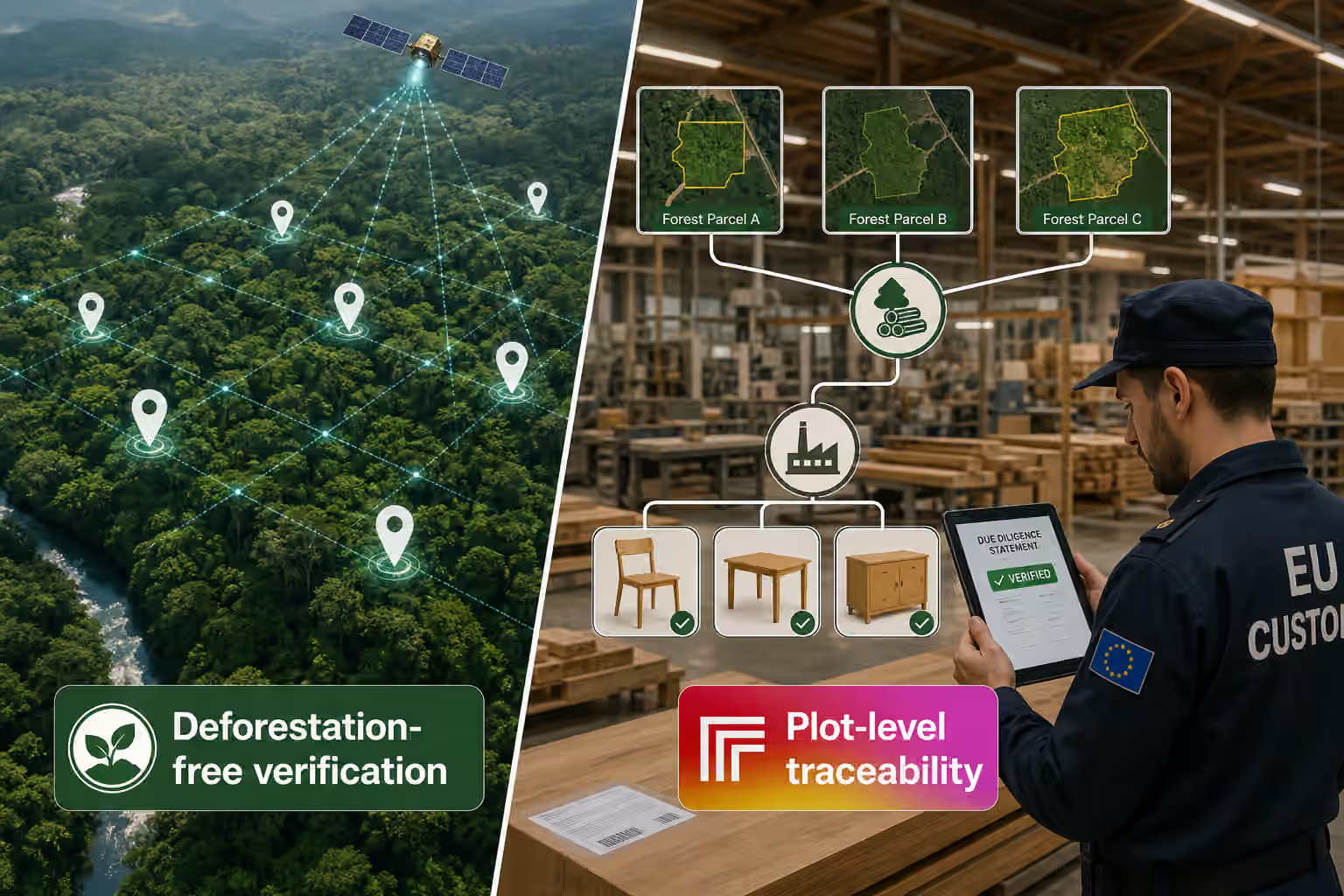
EUDR and timber and wood products: what exporters need to document
The EU Deforestation Regulation covers timber and a wide range of wood-derived products. For exporters in Southeast Asia, Brazil, and other major producing regions, compliance requires plot-level traceability and deforestation verification that most supply chains were not designed to provide. This article explains what is required and where the practical difficulties lie.
This article is for informational purposes only and does not constitute legal advice. Consult a qualified legal professional for advice specific to your situation.
- Timber presents a structurally harder EUDR problem than agricultural commodities because of product complexity, supply chain length, and the existence of a prior regulatory regime. Furniture, paper, and packaging all fall in scope alongside raw logs, and each additional processing step from forest to finished product makes it harder to maintain the traceability link EUDR requires.
- Plot-level GPS geolocation is mandatory for every forest parcel in the chain, with no provision for country-of-origin approximations, and this is by far the hardest requirement for processed products. A single ream of paper or piece of furniture can incorporate wood from multiple forest areas and multiple suppliers, which means component-level origin tracking has to survive every transformation step, not just the first one.
- Existing legality frameworks help less than exporters often assume: a valid FLEGT licence satisfies the legal compliance element of due diligence but not the deforestation-free verification, and FSC or PEFC certification is supporting infrastructure rather than a substitute for EUDR’s own documentation. Indonesian exporters with SVLK certification and timber producers with chain-of-custody certification still have to collect and verify plot-level coordinates independently.
- Brazil and Southeast Asia illustrate different versions of the same core gap: national-level monitoring infrastructure, such as Brazil’s PRODES and DETER satellite systems, can confirm whether deforestation occurred at a location, but individual operators still have to supply that location themselves. Vietnamese furniture manufacturers face a compounding version of the problem, needing to trace every wood component across multiple countries of origin in a single product.
- Under the current timeline set by Regulation (EU) 2025/2650, main obligations apply from 30 December 2026, with a later 30 June 2027 date for micro and small operators already established by the end of 2024. These deadlines fall on the EU operator, not the exporter directly, but the EU operator can only meet them if the exporter has already built the geolocation and traceability data to supply.
Why timber is a different kind of EUDR problem
Timber and wood products present the EU Deforestation Regulation with a compliance challenge that is structurally distinct from agricultural commodities like palm oil or cocoa. The differences are worth understanding before getting into the specific requirements, because they affect where the hard problems actually lie.
The first difference is product complexity. The derived products covered by EUDR for timber are numerous and, in some cases, far removed from the raw material. Furniture, paper, cardboard packaging, wooden flooring, engineered wood panels, charcoal, and printed materials all fall within scope. An importer of flat-pack furniture or a paper manufacturer sourcing pulp from abroad is as subject to the regulation as an importer of raw logs. The more processed the product, the harder it is to maintain a traceable link back to the specific forest parcel where the trees were felled.
The second difference is the existence of prior frameworks. Timber is the only EUDR commodity sector that already had a significant EU regulatory architecture in place before the regulation was adopted. The Forest Law Enforcement, Governance and Trade programme established Voluntary Partnership Agreements with timber-exporting countries, creating licensed legality verification systems that have been operating for years. The EU Timber Regulation, in force since 2013, already prohibited illegally harvested timber from the EU market and required operators to exercise due diligence. EUDR replaces EUTR for timber and adds the deforestation requirement on top. The question of how existing FLEGT licences interact with EUDR compliance is one of the most consequential legal questions in the sector and is addressed below.
The third difference is supply chain length and transformation. A palm oil supply chain runs from plantation through mill to refinery and then to the EU importer. A timber supply chain may run from forest concession through logging operation, sawmill, kiln-drying facility, secondary processor, furniture manufacturer, and exporter before reaching the EU importer. Each transformation step makes it harder to maintain the link between the specific trees felled and the final product placed on the EU market.
What is in scope
The EUDR covers wood itself and a wide range of derived products. The relevant categories under Annex I to the regulation include:
Wood in the rough, whether or not stripped of bark, sapwood, or roughly squared. Wood sawn or chipped lengthways, sliced or peeled, whether or not planed, sanded, or end-jointed. Wood in chips or particles, wood waste and scrap, wood in the form of pellets or briquettes. Wooden railway sleepers. Sheets for veneering, sheets for plywood, and densified wood. Builders’ joinery and carpentry of wood, including cellular wood panels. Tableware and kitchenware of wood. Wooden furniture and parts thereof. Paper and paperboard, including pulp and recovered paper products. Printed materials such as books and newspapers were removed from scope by Regulation (EU) 2025/2650, the EUDR amending regulation published on 23 December 2025.
The inclusion of paper and packaging extends the scope of the regulation well beyond what most businesses in those sectors initially anticipated. A retailer importing cardboard packaging or a company sourcing paper office supplies from non-EU suppliers is handling in-scope products if those products involve wood-derived materials from relevant origins. The operator placing the product on the EU market for the first time bears the compliance obligation, but only the upstream supply chain can generate the documentation they need.
The specific documentation requirements
For timber and wood products, an EU operator must collect and verify the following before placing products on the EU market.
Plot-level geolocation data. The regulation requires GPS coordinates identifying the specific forest parcels or logging areas where the timber was harvested. For concession-based commercial forestry, this means the boundaries of the concession or the specific compartments within it where felling occurred. For plantation forestry, it means the plot boundaries of the plantation. There is no provision for country-of-origin declarations or regional approximations. The geolocation data must identify where the trees actually stood. For micro or small primary operators, meaning natural persons or micro and small enterprises established in a low-risk country who place on the market or export commodities they themselves produced, Regulation (EU) 2025/2650 permits a postal address of the relevant plots of land or establishment to substitute for precise geolocation coordinates, provided the postal address clearly corresponds to the geographic location. This substitution is not available to other operators, downstream operators, or traders.
For highly processed products such as paper or furniture, this requirement is demanding in a way that has no easy analogy in agricultural commodities. A ream of paper may contain pulp derived from trees felled across multiple forest areas by multiple suppliers. A piece of furniture may incorporate wood components sourced from different species in different countries. Maintaining parcel-level traceability through multiple transformation steps requires documentation systems that most supply chains do not currently have.
Deforestation-free verification. Using the plot coordinates, the operator must verify that the relevant forest area was not subject to deforestation after 31 December 2020. For timber, this involves cross-referencing the harvest coordinates against satellite-based forest cover monitoring data. The verification is straightforward in principle but depends entirely on the accuracy of the coordinates provided. A concession boundary that has not been formally surveyed, or a plantation plot whose coordinates were estimated rather than measured, will not produce a reliable verification result.
Legal compliance declaration. The operator must hold documentation confirming that the timber was harvested in compliance with the laws of the country of production. For timber, this covers harvesting rights and concession authorisations, environmental permits, and compliance with applicable labour law. This is where the FLEGT question becomes directly relevant, which is addressed separately below.
Supply chain traceability records. The operator must be able to trace the product from the harvest area through every step of the supply chain to the EU market. For timber, this means documentation covering the log from felling through transport and primary processing at the sawmill, through any secondary processing, manufacturing, or transformation steps, to the point of export. Where multiple origins are blended at any point in the chain, the traceability requirement becomes significantly more difficult to satisfy.
The FLEGT question: do existing licences help?
The Forest Law Enforcement, Governance and Trade programme established Voluntary Partnership Agreements between the EU and timber-exporting countries. Countries with operational VPAs issue FLEGT licences for timber exports, certifying that the timber was legally harvested under a government-verified system. Indonesia has had an operational VPA and licensing scheme in place since 2016. Ghana, Cameroon, the Central African Republic, Honduras, and Vietnam are at various stages of VPA negotiation or implementation.
The EU Timber Regulation, which EUDR replaces for timber, gave FLEGT-licensed timber a significant compliance advantage: it was treated as legally harvested without further due diligence. The question for the timber sector when EUDR was adopted was whether this equivalence would carry over.
The answer is partial and conditional. EUDR does not grant FLEGT-licensed timber an automatic exemption. The regulation requires deforestation-free verification as well as legal compliance, and FLEGT licences address legality, not deforestation. A timber consignment can be legally harvested under a valid FLEGT licence and still originate from a forest area that experienced deforestation after 31 December 2020. The legal compliance element of EUDR due diligence is satisfied by a valid FLEGT licence. The deforestation element is not.
Use the EUDR commodity & country checker to look up due diligence obligations and country risk tiers for any of the seven covered commodities.
This is a significant point for Indonesian exporters in particular. Indonesia’s SVLK timber legality verification system is the basis of its FLEGT licensing scheme, and Indonesian timber exporters have invested considerably in SVLK certification over the past decade. That investment provides real value for the legal compliance component of EUDR due diligence. It does not eliminate the need to collect and verify plot-level geolocation data.
The European Commission has indicated that it will consider how recognised legality frameworks interact with EUDR compliance as implementation progresses. But as of the current application dates, FLEGT-licensed timber must still satisfy the full geolocation and deforestation verification requirements of the regulation.
The Southeast Asian supply chain problem
Indonesia and Vietnam are the two most significant Southeast Asian exporters of timber and wood products to the EU. Their supply chains present different versions of the same core challenge.
Indonesia’s commercial forestry sector is divided between natural forest concessions, which produce logs and sawn timber from native forest, and plantation concessions, which produce timber from planted species including acacia and eucalyptus for pulp and paper. The natural forest concession sector has faced significant pressure from illegal logging, land conversion, and overlapping tenure claims for decades. The SVLK system has improved legality documentation substantially, but the spatial data held within the system varies in accuracy and completeness. Converting SVLK documentation into the specific geolocation format EUDR requires is not a straightforward exercise for all concession holders.
The plantation sector, which supplies the pulp and paper industry, has somewhat better spatial documentation because plantation management inherently requires knowing where trees are planted. But the derived product complexity discussed above applies with full force here: paper and pulp products involve blending from multiple plantation areas, and maintaining the traceability link from specific plantation parcels through to specific export consignments of paper or paperboard is a significant data management challenge.
Vietnam has developed a substantial wood processing and furniture manufacturing sector that sources timber domestically and from a range of other countries including the United States, Chile, and various African and Asian origins. The challenge for Vietnamese furniture exporters is that EUDR compliance requires them to trace not just their immediate timber inputs but the origin forest parcels for all wood components in their products. A Vietnamese furniture manufacturer importing American hardwood, plantation teak from Myanmar, and domestic plantation timber for different components in the same product must satisfy EUDR requirements for all three origins simultaneously.
Myanmar is a significant complicating factor for the region. It was a major source of teak and other hardwoods for Vietnam’s furniture sector before the military coup in 2021 prompted significant EU trade restrictions. The combination of EUDR requirements and existing trade policy considerations has effectively closed the EU market for products containing Myanmar timber, but the documentation challenge of proving the absence of Myanmar-origin wood in complex supply chains remains real for Vietnamese manufacturers who previously sourced from there.
The Brazilian supply chain problem
Brazil is the world’s largest tropical forest nation and a major exporter of timber and wood products. Its EUDR compliance challenge is shaped by the scale and diversity of its forestry sector, the documented history of illegal deforestation in the Amazon and Cerrado biomes, and the complexity of land tenure in frontier agricultural and forestry areas.
Brazil’s commercial forestry sector operates under a concession system in public forests, managed by the Brazilian Forest Service, and through private land holdings where forest management plans are required for native timber harvesting. The documentation systems for both are more developed than in many other tropical timber-producing countries, but the accuracy and completeness of spatial data varies considerably between regions and concession holders.
The Amazon monitoring infrastructure in Brazil is among the most sophisticated in the world. The PRODES and DETER satellite monitoring systems, operated by Brazil’s National Institute for Space Research, provide near-real-time deforestation alerts and annual deforestation assessments. This monitoring data is directly usable for EUDR deforestation verification purposes, and Brazil has engaged constructively with the European Commission on how it can support compliance. However, the availability of monitoring data at national level does not eliminate the need for individual operators to collect and submit plot-level coordinates. The monitoring system can verify whether deforestation occurred at a given location. The operator must still provide the location.
The certification question
Timber has a more mature and more varied sustainability certification ecosystem than almost any other EUDR commodity. The Forest Stewardship Council and the Programme for the Endorsement of Forest Certification both operate internationally recognised chain-of-custody certification schemes that trace certified timber from certified forests through the supply chain to the final product. FSC and PEFC certification are widely held by timber producers, processors, and manufacturers supplying EU markets.
The question of whether FSC or PEFC certification satisfies EUDR requirements has the same answer as for other certification schemes in other commodity sectors: it does not substitute for the specific documentary requirements of the regulation.
FSC and PEFC chain-of-custody certification establishes that certified material has been tracked through the supply chain from a certified forest. FSC-certified forests are required to maintain spatial documentation of their management areas. This documentation may be directly usable as input into EUDR geolocation compliance. But the certification itself is not a shortcut, and the deforestation verification requirement applies regardless of certification status.
The European Commission has discussed with FSC and PEFC whether their frameworks could be recognised as supporting simplified due diligence under EUDR. Neither has been formally recognised as of the current application dates. The Commission has signalled openness to recognising frameworks that demonstrably address both legality and deforestation, but the criteria and process for such recognition have not been finalised.
For operators holding FSC or PEFC chain-of-custody certification, the practical position is that certification provides a useful starting point for EUDR compliance. The spatial data requirements of certification audits may generate some of the geolocation information EUDR requires. The chain-of-custody documentation maintained for certification purposes overlaps with, but does not fully satisfy, the traceability records EUDR requires. Certification should be treated as supporting infrastructure for EUDR compliance, not as a replacement for it.
The application timeline and what it means in practice
The EUDR’s application date has been postponed twice since the regulation was adopted. Under the current rules, set by Regulation (EU) 2025/2650 and published in the Official Journal on 23 December 2025, the main obligations apply from 30 December 2026. A narrower exception applies to operators who are natural persons or micro or small undertakings already established as such by 31 December 2024: for them, the same obligations apply from 30 June 2027. These deadlines apply to the EU operator, downstream operator, or trader, not to the non-EU exporter directly. But the EU operator can only satisfy the regulation if the exporter provides the required data.
For the timber sector, the complexity of the derived products scope means that the application of these deadlines is less straightforward than for primary commodities. An EU manufacturer using imported wood components in a product it then places on the EU market for the first time is an operator under the regulation. An EU retailer importing finished wooden furniture for the first time is an operator. The compliance obligations extend well beyond importers of raw logs and sawn timber, though where a product has already been covered by an upstream due diligence statement or simplified declaration, the EU business receiving it is instead a downstream operator or trader, with a lighter obligation: register in the information system and, if it is the first downstream operator or trader in the chain, retain the upstream reference number or declaration identifier, rather than submit a due diligence statement of its own.
Non-EU exporters of finished wood products need to understand that their EU customers may face direct operator obligations under EUDR, not merely downstream exposure. A Vietnamese furniture manufacturer’s EU retail customer, if it is the business placing the product on the EU market for the first time, is an operator required to conduct due diligence and submit a due diligence statement. That EU retailer needs the Vietnamese manufacturer to provide geolocation and traceability data covering all wood components in the products it supplies.
What exporters need to build
The practical preparation for EUDR compliance for timber and wood product exporters involves workstreams that reflect the specific characteristics of the sector.
Concession and plantation mapping. Building accurate GPS boundary data for all forest areas supplying the export operation. For concession-based producers, this means ensuring that concession boundaries and compartment-level harvest records are in a format that can be used for EUDR verification. For plantation producers, it means plot-level boundary data for all cultivation areas. Where spatial data exists but is not in the right format or level of accuracy, investment in survey or remote sensing work is required.
Component-level origin tracking for processed products. For manufacturers of furniture, paper, or other derived products, building the internal data systems to associate specific wood components with their source parcels. This is the most technically demanding workstream for complex manufactured products. It requires changes to procurement documentation, production records, and inventory management systems to maintain the origin link through multiple manufacturing steps.
Deforestation verification. Running the parcel coordinates against satellite forest cover data to verify deforestation-free status as of 31 December 2020, and establishing a process for verifying new sources as they enter the supply chain. Automated verification services are available for this, but their reliability depends on the accuracy of the input coordinates.
Legal compliance documentation. Assembling the documentation that supports the legal compliance declaration: concession or land use authorisations, harvest permits, environmental approvals, and labour law compliance records. For FLEGT-licensed Indonesian exporters, the SVLK documentation already assembled for licensing purposes provides a significant starting point for this workstream, though it will need to be supplemented with the geolocation and deforestation verification elements EUDR adds.
Supply chain disclosure systems. Establishing the documentation trail from forest parcel to export consignment in a format that EU customers can use to satisfy their obligations, whether that customer is the operator submitting a full due diligence statement or a downstream operator or trader retaining an upstream reference number or declaration identifier. This means understanding exactly what data format and level of detail each EU customer requires, where that customer sits in the supply chain, and building the internal systems to generate and deliver the right information consistently at consignment level.
The timber sector faces a more complex compliance infrastructure challenge than most other EUDR-covered commodities, because of the length of the processing chain and the breadth of the derived products scope. The businesses that will be best positioned are those that treat this as a data management and systems problem, and have started the foundational work of building accurate spatial records and supply chain documentation before EU customer deadlines make the timeline unmanageable.
A plain-English explanation of what the EUDR requires across all covered commodities is available here: EUDR explained: what the EU Deforestation Regulation requires and who it affects.
For the equivalent analysis of palm oil supply chains, see: EUDR and palm oil: what Indonesian and Malaysian exporters must now prove.
For cocoa supply chains, see: EUDR and cocoa: what West African and Southeast Asian producers need to know.
Check country risk tiers and commodity obligations directly: EUDR commodity & country checker.
Verdandi monitors EUDR developments continuously, including the country benchmarking classifications and any framework recognition decisions that will affect the compliance burden for timber exporters. Start for free.
A foundational explainer on the EU's supervisory architecture for financial services. Who writes the technical standards, who enforces them, how national competent authorities fit in, and where the new Anti-Money Laundering Authority changes the picture.