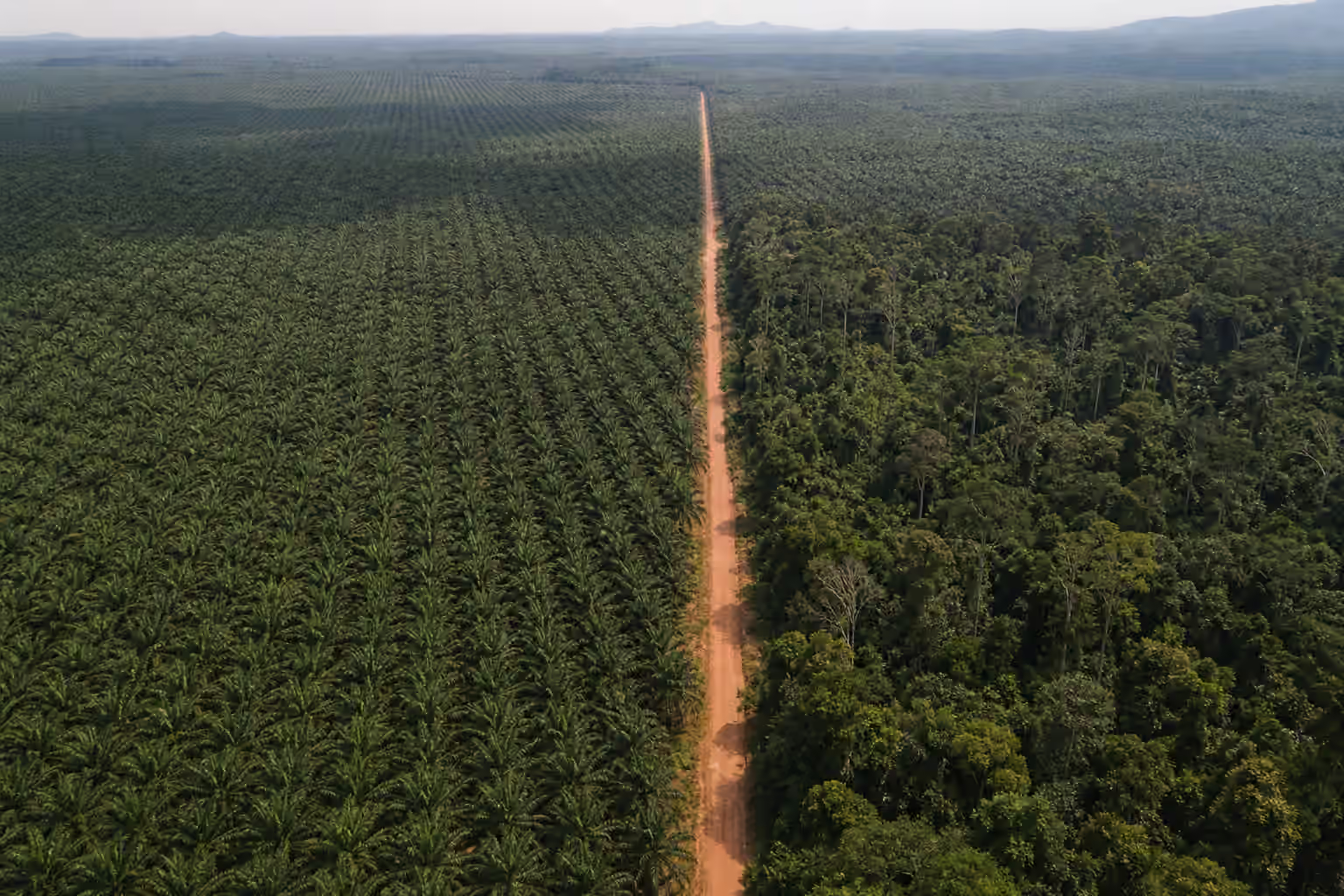
EUDR and palm oil: what Indonesian and Malaysian exporters must now prove
The EU Deforestation Regulation creates specific documentation requirements for palm oil producers and exporters supplying the EU market. This article explains what is required, where the practical difficulty lies, and what Indonesian and Malaysian suppliers need to prepare.
This article is for informational purposes only and does not constitute legal advice. Consult a qualified legal professional for advice specific to your situation.
- Palm oil is EUDR’s most complex case because Indonesia and Malaysia account for 85 percent of global production, both have experienced significant forest loss since the 31 December 2020 reference date, and supply chains sourcing from smallholder farmers are among the most difficult to trace to plot level. EU importers who cannot satisfy the regulation’s requirements cannot legally place palm oil on the EU market. Exporters who cannot provide the right documentation will lose EU market access regardless of product quality or price.
- EUDR requires plot-level geolocation data, deforestation-free verification against the 31 December 2020 baseline, legal compliance declarations (land use rights, environmental protection, labour law), and supply chain traceability records from farm to export. For palm oil, this means GPS coordinates for every parcel where fruit was harvested, satellite verification of no deforestation post-2020, substantiated legal compliance documentation, and continuity of custody records at every handover point from fresh fruit bunch to mill to refinery to exporter.
- Indonesian supply chains face the hardest problems: 2.7 million smallholder farmers, many without formal land titles or surveyed plots, aggregated through mills that historically have not needed to know the exact location of every source plot. Converting informal boundaries into accurate GPS coordinates, handling customary land tenure without formal documentation, and upgrading mill systems to capture plot-level data from thousands of farmers is a multi-year programme, not a one-time exercise.
- Malaysian challenges are concentrated in Sabah and Sarawak, where smallholder production, native customary rights tenure, and historical deforestation create similar documentation difficulties. Estate production in peninsular Malaysia is more tractable. Malaysia has engaged with the Commission on benchmarking and national monitoring systems that could support simplified due diligence for certified sustainable production, but no equivalence has been recognised and certification (ISPO, MSPO) does not substitute for EUDR compliance.
- Application dates: large operators and traders must comply from 30 December 2026; micro and small enterprises from 30 June 2027. The postponement from 2025 should not be read as a softening of requirements. Supply chains take months to build to compliance. Exporters need to build farmer data collection (plot GPS), deforestation verification (satellite cross-checking), legal compliance documentation, mill and refinery traceability systems, and consignment-level data delivery to EU buyers. The businesses that started early will be best positioned when EU buyers scale up their data requirements.
Why palm oil is the regulation’s most complex case
Palm oil is the commodity where the EU Deforestation Regulation bites hardest. Indonesia and Malaysia together account for around 85 percent of global palm oil production. Both countries have experienced significant forest loss in palm oil growing areas since the reference date the regulation uses: 31 December 2020. And palm oil supply chains, particularly those sourcing from smallholder farmers, are among the most difficult to trace to plot level.
The result is that EUDR compliance is a serious operational challenge for Indonesian and Malaysian exporters, not a documentation formality. EU importers who cannot satisfy the regulation’s requirements cannot legally place palm oil or palm-derived products on the EU market. Exporters who cannot provide the right information will lose EU market access regardless of the quality or price of their product.
This article explains what the regulation requires for palm oil specifically, where the genuine difficulties lie, and what suppliers need to start building now.
What is in scope
The EUDR covers palm oil itself and a wide range of derived products. The relevant categories under Annex I to the regulation include:
Crude palm oil and its fractions. Refined palm oil and palm kernel oil. Palm-based fats used in food manufacturing, including partially hydrogenated variants. Oleochemicals derived from palm, including fatty acids, fatty alcohols, and glycerol. Preparations containing palm oil as a significant ingredient, including certain margarines and shortenings.
The breadth of derived products means that palm oil enters the EUDR compliance perimeter not only in its refined form but as an ingredient in products that may not appear obviously connected to deforestation. A food manufacturer importing palm-based emulsifiers, a cosmetics importer sourcing palm-derived surfactants, and a cleaning products company importing palm fatty acids are all handling in-scope commodities. Their EU importers bear the compliance obligation, but they can only fulfil it if the upstream supply chain provides the right documentation.
The EUDR palm oil obligations checker covers the full list of CN codes in scope and the due diligence requirements by role.
The specific documentation requirements
For palm oil, compliance with EUDR requires an EU operator to collect and verify the following before placing the product on the EU market.
Plot-level geolocation data. The regulation requires GPS coordinates sufficient to identify the specific parcel or parcels of land where the palm fruit was harvested. For estate production from a single large plantation, this may be a manageable number of polygons or points. For supply chains aggregating fruit from independent smallholders, it means collecting individual plot coordinates from every farmer whose fruit entered the supply chain. There is no provision for regional or district-level approximation. The geolocation data must identify the actual land.
Deforestation-free verification. The operator must be able to verify, using the geolocation data, that the land was not subject to deforestation or forest degradation after 31 December 2020. In practice this means cross-referencing the plot coordinates against satellite forest cover data. Several third-party services now offer automated EUDR verification against this standard, but the underlying geolocation data must be accurate for the verification to be valid. A coordinate that locates a farmer’s plot in the wrong location, or that represents a village centre rather than the actual cultivation area, will not pass verification.
Legal compliance declaration. The operator must hold a statement confirming that production complied with the relevant legislation of the country of production. For Indonesia and Malaysia, this covers land use rights and permits, environmental protection requirements, and applicable labour law. The declaration must be substantiated, meaning it cannot be a bare assertion. Supporting documentation showing that the producer holds valid land titles or cultivation permits and is operating within authorised land use categories is required.
Supply chain traceability records. The operator must be able to trace the product from the production parcels to the point of export. For palm oil this typically means documentation covering the fresh fruit bunch from farm to mill, the crude palm oil from mill to refinery, and the refined product from refinery to exporter. Each handover point in that chain needs to be documented with sufficient detail to establish continuity of custody.
Where Indonesian supply chains face the hardest problems
Indonesia has approximately 2.7 million smallholder palm oil farmers. Many are independent growers who sell fresh fruit bunches to local collection points or directly to mills. They may not have formal land titles. Their plots may not have been formally surveyed. Their awareness of what GPS coordinates are, let alone how to obtain them, varies considerably.
Mills aggregating fruit from independent smallholders face a structural challenge: they have historically not needed to know the exact location of every plot supplying them. The fruit arrives, is weighed, and is processed. The price paid reflects the grade of the fruit, not its geographic origin. Building the traceability infrastructure to associate specific batches of processed palm oil with specific source plots is a significant operational change.
Several practical problems compound this.
Plot boundaries in smallholder areas are often defined by physical markers, trees, or informal agreements rather than surveyed boundaries. Converting these into GPS coordinates that accurately represent the plot extent requires either field surveys or satellite-assisted mapping, both of which require resources and take time.
Land tenure in some smallholder areas is informal or customary rather than based on formal title. A farmer who has cultivated the same plot for decades may not have documentation that satisfies a formal land rights verification. This is not necessarily an indicator of illegality, but it creates a gap in the documentation chain that EU importers may not know how to handle.
The concentration of processing through mills means that traceability depends on mills maintaining plot-level data about their supplier farmers. Many mills have not built systems to capture this. Upgrading those systems, training procurement staff, and engaging thousands of individual smallholder suppliers to provide location data is a multi-year programme, not a one-time exercise.
Where Malaysian supply chains face different but related challenges
Malaysia’s palm oil sector has a higher proportion of estate production than Indonesia’s, which makes plot-level traceability somewhat more tractable for the large integrated producers. The major plantation groups have the technical and financial capacity to build EUDR-compliant documentation systems and several have done so.
The challenge in Malaysia is concentrated in Sabah and Sarawak, where a combination of smallholder production, complex land tenure arrangements under native customary rights, and historical deforestation in proximity to active cultivation areas creates the same kinds of documentation difficulties as in Indonesian smallholder supply chains. The risk classification of specific regions under the EUDR benchmarking system, which the Commission is expected to finalise ahead of the application dates, will affect how intensively these supply chains are scrutinised.
Malaysia has also been more active than Indonesia in engaging with the Commission on the benchmarking methodology and on the provision of national monitoring systems that could support simplified due diligence for certified sustainable production. Whether those engagements translate into a more favourable benchmarking classification remains to be seen, but the outcome will significantly affect the compliance burden for Malaysian exporters supplying certified product.
The certification question
Both Indonesia and Malaysia have national sustainability certification schemes for palm oil: the Indonesian Sustainable Palm Oil standard and the Malaysian Sustainable Palm Oil standard. A common question from exporters is whether holding ISPO or MSPO certification satisfies EUDR requirements.
The short answer is that certification does not substitute for EUDR compliance. The EUDR is a market access regulation with specific documentary requirements. It does not recognise third-party certification schemes as a substitute for due diligence. An operator placing certified palm oil on the EU market must still collect plot-level geolocation data, verify deforestation-free status against the 31 December 2020 baseline, and submit a due diligence statement.
Certification may be relevant as supporting evidence within the broader due diligence process. A certified producer operating under an audited scheme that includes land mapping and deforestation monitoring may be better placed to provide the required documentation than an uncertified producer, because the certification process will have generated some of the underlying data. But the certification itself is not a shortcut.
The EU has engaged with producer country governments on the question of equivalence, and there is ongoing discussion about whether strengthened versions of national schemes could support some form of simplified due diligence in the future. As of the current application dates, no such equivalence has been recognised.
The application timeline and what it means in practice
The EUDR’s application date has been postponed twice since the regulation was adopted. Under the current rules, set by Regulation (EU) 2025/2650 and published in the Official Journal on 23 December 2025, medium and large operators, downstream operators, and traders must comply from 30 December 2026, while micro and small enterprises have until 30 June 2027. This applies to the EU importer’s classification, not to the supplier’s size. The amended regulation also distinguishes between operators, who place the product on the EU market for the first time or export it and bear the full due diligence obligation, and downstream operators or traders further along the chain, who have identical obligations to each other and no longer submit their own due diligence statement, though only the first downstream operator or trader in the chain must retain the upstream reference number and supporting documentation.
For large EU importers of Indonesian and Malaysian palm oil, the 30 December 2026 application date gives a further runway beyond the originally planned 2025 date, but it does not reduce the underlying due diligence obligation for the operator placing the product on the EU market for the first time. Suppliers who have not built the documentation infrastructure to support this requirement will still create problems for their EU buyers once the date arrives, and the postponement should not be read as a softening of what will eventually be required.
For micro and small importers, the June 2027 deadline provides a longer window, and micro and small primary operators sourcing from low-risk countries may also be eligible for a simplified one-off declaration rather than a full due diligence statement. But supply chains cannot be made EUDR-compliant in weeks regardless of which deadline applies. The plot data collection, verification, and documentation systems that compliance requires take months to build properly. An exporter whose primary EU customers are smaller importers should not interpret the later deadline as permission to defer preparation, particularly since the European Commission is due to publish a further simplification review by 30 April 2026 that could affect requirements again before either deadline arrives.
What exporters need to build
The practical preparation for EUDR compliance for Indonesian and Malaysian palm oil exporters involves several distinct workstreams.
Farmer data collection. Building a database of plot-level GPS coordinates for every smallholder supplier, or at minimum for every smallholder whose fruit can be traced into specific export consignments. This requires field engagement, often through existing extension networks or buyer relationships, and a mechanism for keeping the data current as land is subdivided, sold, or brought under new cultivation.
Deforestation verification. Running the plot coordinates against satellite-based forest cover data to identify any parcels with deforestation events after 31 December 2020. This is a one-time exercise for historical data but needs to be repeated for any new suppliers or newly identified parcels. Third-party verification services can automate much of this, but the input data quality determines the output reliability.
Legal compliance documentation. Assembling the documentation that supports the legal compliance declaration: land use permits, cultivation licenses, environmental permits, and evidence of labour law compliance. For large estates this may be a document organisation exercise. For smallholder supply chains it requires working with individual farmers or their cooperatives to obtain and digitise the relevant documentation, where it exists.
Mill and refinery traceability systems. Ensuring that the processing and refining steps in the supply chain maintain the link between specific batches of processed oil and specific source parcels. This typically requires changes to mill intake procedures, weighbridge recording systems, and lot management practices at refineries.
Due diligence statement preparation. Submitting the due diligence statement (or, where eligible, the simplified declaration) is the obligation of the operator placing the product on the EU market for the first time, not the exporter’s. But that operator can only make that submission if the exporter has provided the underlying data: geolocation coordinates, deforestation-free verification, and legal compliance documentation, assembled at consignment level. Where the EU buyer is a downstream operator or trader rather than the operator placing the product on the market for the first time, it will instead need the upstream reference number and supporting documentation to satisfy its own retention obligations. Exporters need to understand exactly what their EU buyers require for each shipment, and where in the supply chain those buyers sit, and build the internal systems to produce and deliver the right data consistently.
None of these workstreams is straightforward for supply chains that were not designed with this kind of traceability in mind. The businesses that will be best positioned when EU buyers scale up their EUDR data requirements are those that started the data collection and system-building work early, before the pressure of a specific buyer deadline made the timeline unmanageable.
A plain-English explanation of what the EUDR requires across all covered commodities is available here: EUDR explained: what the EU Deforestation Regulation requires and who it affects.
Verdandi monitors EUDR developments continuously, including the country benchmarking classifications that will determine the due diligence burden for Indonesian and Malaysian exporters. Start for free.
MiCA has been in full application since December 2024. The implementing regulation layer continues to develop. This article explains what compliance monitoring tools actually cover for MiCA, where generic AI tools fail, and what source-anchored monitoring provides that nothing else does.