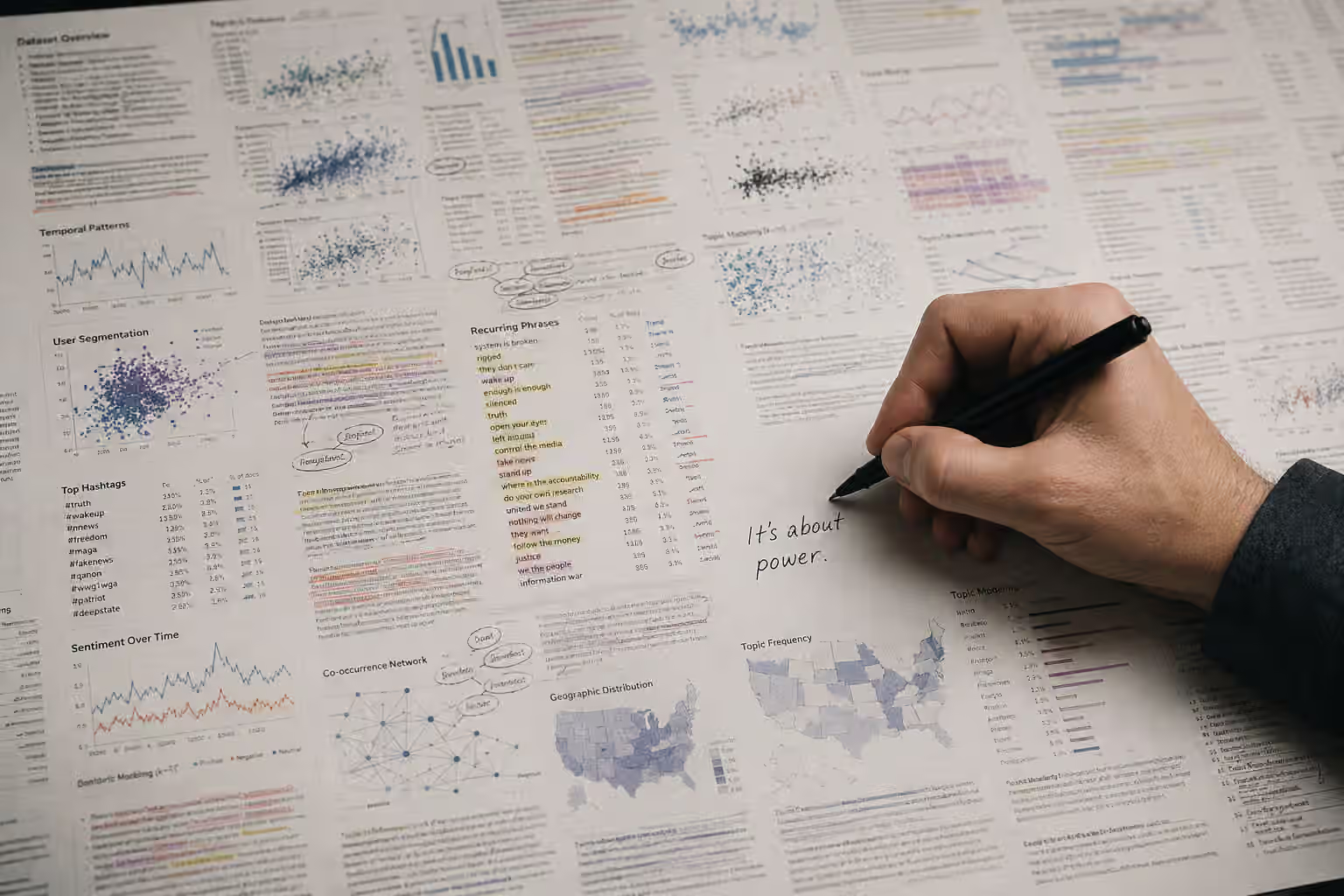
Pattern recognition is not insight
AI systems surface patterns at scale. Researchers surface meaning. The gap between those two things is not a technical problem. It is where professional judgment lives.
- A pattern is a signal that repeats. Insight is an interpretation of that pattern in a specific context, by someone with enough knowledge of that context to know what it means and what it implies for a decision. The pattern is the raw material. The insight is the thing that changes how someone thinks or acts. AI tools surface patterns well. They do not close the gap between pattern and meaning.
- The same pattern can support meaningfully different interpretations, each pointing to a different decision. A recurring complaint about a banking app’s balance display might indicate a data quality problem, an explanation problem, a broader trust deficit, or an onboarding failure. The data does not contain the answer. The answer depends on knowledge of the product, the client history, and the decisions the organisation is actually capable of making.
- Fluent, confident AI output makes it easier to mistake a dressed-up pattern for an insight. A generic framing attached to a pattern reads like a finding and feels like the work is done. The practitioner has to actively resist that pull and ask whether the interpretation is actually supported for this specific context, with this specific client, given what they know that the system does not.
- Scaling pattern recognition with AI shifts the bottleneck, it does not remove it. More patterns surface faster, but interpretive capacity does not scale at the same rate. The constraint is now the ability to evaluate which patterns matter, in what order, for which decisions. That bottleneck is a human one, and it is the same bottleneck that existed before, just more visible.
What a pattern actually is
A pattern is a signal that repeats. In research data, patterns are everywhere: a phrase that appears across fifty interviews, a sentiment that clusters around a product attribute, a drop in satisfaction scores that correlates with a feature change. Any competent system, AI or otherwise, can be trained to detect them. Modern tools do it well. Some do it at a scale no human analyst could match unaided.
This capability is useful. It is also routinely mistaken for the harder thing.
Insight is not a pattern. Insight is an interpretation of a pattern in a specific context, by someone with enough knowledge of that context to know what the pattern means, why it matters, and what it implies for a decision. The pattern is the raw material. The insight is the thing that changes how someone thinks or acts.
The confusion between the two has become more consequential as AI tools have become more capable of surfacing patterns quickly and confidently. When a tool presents a pattern in fluent prose, the leap to “this is the insight” becomes easier to make without noticing. It is still a leap. Someone still has to make it deliberately.
The same pattern, different meanings
Consider a recurring complaint about a banking app. Across five hundred user interviews, a theme emerges: customers say they do not trust the balance displayed on the home screen. The pattern is clear and consistent. The AI tool that surfaced it has done its job correctly.
Now consider what the insight might be. There are at least four meaningfully different interpretations:
The balance display is technically unreliable: pending transactions are shown inconsistently, and customers are responding rationally to a real data quality problem. The fix is engineering.
The balance display is technically accurate, but the interface does not communicate how it calculates the figure. Customers do not understand what they are looking at. The fix is explanation, not accuracy.
The trust problem is not about the balance at all. The bank has a broader trust deficit, and the balance screen is where customers first encounter it. The fix requires understanding what damaged trust in the first place.
The customers describing distrust are a specific segment, new users in the first ninety days, and the pattern disappears among long-term users who have learned the app’s logic. The fix is onboarding, not the feature.
Each interpretation points to a different decision. None of them is readable from the pattern alone. The pattern says “customers do not trust the balance display.” The insight is one of those four things, or something else entirely, and it depends on knowledge the data does not contain: the technical architecture of the product, the history of the customer relationship, the composition of the interview sample, the decisions the business is actually capable of making.
A researcher who has run ten projects for this client, who understands the product roadmap, who was in the room when the last set of findings was ignored because engineering said it was too expensive, who knows which interpretation the stakeholder can act on this quarter, is positioned to make that call. That knowledge does not live in the dataset. It compounds in the practitioner.
Why confident output makes this harder
The operational problem with AI-generated pattern summaries is not that they are wrong. It is that they are fluent and confident regardless of how much interpretive work they have actually done.
A tool that surfaces the balance-trust pattern will typically present it with a framing. “Users express distrust around the balance display, suggesting a need for greater transparency.” That framing sounds like an insight. It is a dressed-up pattern with a generic recommendation attached. It is not wrong. It is just the interpretation that requires the least context to produce, and therefore the one least likely to be specific enough to be useful.
The researcher who stops here has not done the work. The researcher who reads that output and knows immediately that “transparency” is the wrong frame for this client, because they tried a transparency intervention eighteen months ago and it did not move the metric, is doing interpretation. They are bringing knowledge the system cannot have.
The challenge is that the fluent, confident output makes it easy to feel like the work is done. It is presented as a finding. It reads like a finding. The practitioner has to actively resist the pull of that framing and ask whether the interpretation is actually supported, specifically, for this context.
Pattern recognition at scale creates a new problem
There is a secondary issue that becomes visible when AI tools operate at genuine scale. When a tool processes five thousand interviews rather than fifty, it surfaces more patterns, more consistently, with more confidence. The volume of pattern output increases faster than the capacity to interpret it.
This is not a failure of the tool. The tool is working as intended. But it shifts the bottleneck in the research process. The constraint is no longer data collection or even data processing. It is interpretive capacity: the ability to evaluate which patterns matter, in what order of priority, for which decisions, given what the organisation is currently positioned to do.
That bottleneck is a human bottleneck. It is, in fact, the same bottleneck that existed before AI tools, just more visible now because the pattern-surfacing step has been automated and accelerated while the interpretation step has not.
The practitioners who will be most valuable in this environment are not the ones who can operate the tools most fluently. They are the ones who can move from pattern to meaning most reliably, for a specific client and context, across the full range of complexity that real decisions involve.
The judgment that does not automate
What makes interpretation possible is a set of things that accumulate through practice and do not transfer through prompting.
One is understanding of the decision context: what the organisation is trying to do, what it has already tried, what constraints it is operating under, what it is capable of acting on. This knowledge is often tacit and client-specific. It is not in the brief. It is in the researcher’s memory of previous projects, conversations, and outcomes.
Another is calibrated scepticism: the ability to look at a pattern and ask whether it is real. Sampling artefacts, moderator effects, question framing, and participant selection can all produce patterns that look robust and are not. The researcher who has seen the same pattern appear and then fail to replicate knows to ask the question. The system that produces the pattern does not.
A third is prioritisation under ambiguity. Real research briefs are rarely as clean as they appear. The stated question is often not the most important question. The most actionable insight is often not the loudest signal in the data. Deciding which pattern matters most, for this client, right now, requires a kind of judgment that cannot be reduced to a rule.
These are not things a researcher learns to do in a single project. They are capacities that develop across a career and are specific to contexts: an industry, a type of client, a category of research question. They are the things that make one researcher’s output qualitatively different from another’s on the same dataset, even when both are using the same tools.
What this means in practice
None of this is an argument against using AI tools to surface patterns. The capacity to process large volumes of data and identify what recurs across them is genuinely valuable, and doing it manually at scale is slow and inconsistent.
The argument is about where the research process actually ends. Pattern surfacing is a step in the process. It is not the deliverable. The deliverable is an interpretation of what those patterns mean, made by someone who has the context to make it responsibly.
In practice, this means the researcher’s job does not shrink when AI tools surface patterns faster. It shifts. The time freed from data processing is the time that needs to go into interpretation: sitting with the patterns, pressure-testing the obvious framings, asking what else the data could mean, and bringing knowledge of the client and context that the tool does not have.
The systems that work are the ones that treat AI as infrastructure for the step it can do reliably, and keep the practitioner at the centre of the step it cannot.
Next up
The Corporate Sustainability Due Diligence Directive requires large EU companies to identify, prevent, and mitigate human rights and environmental harms across their supply chains. This guide explains who is in scope, what due diligence actually requires in practice, and why the obligations create real consequences for non-EU suppliers.