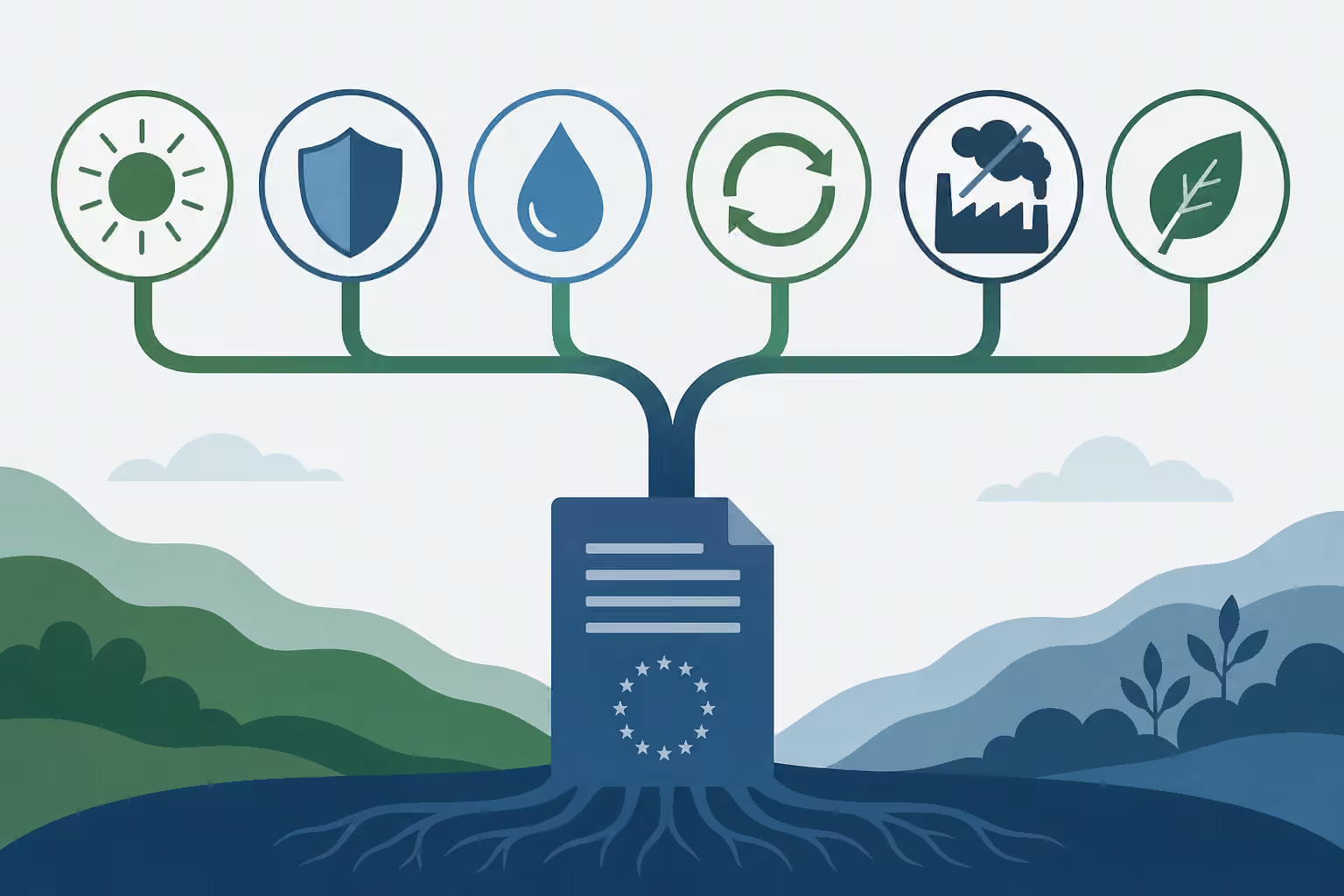
The EU Taxonomy explained: what it is and why it affects more than just financial firms
The EU Taxonomy is the classification system that defines what counts as an environmentally sustainable economic activity. Originally designed for financial markets, it now sits at the centre of CSRD reporting and affects how non-financial companies are assessed by their investors, lenders, and EU buyers.
This article is for informational purposes only and does not constitute legal advice. Consult a qualified legal professional for advice specific to your situation.
- The EU Taxonomy is the classification system that defines what counts as an environmentally sustainable economic activity. It creates a single EU-wide definition, with detailed technical criteria, for when an economic activity genuinely contributes to environmental objectives. CSRD requires companies in scope to disclose what proportion of their revenue, capital expenditure, and operating expenditure is Taxonomy-aligned.
- Alignment requires meeting three conditions simultaneously. The activity must make a substantial contribution to at least one of six environmental objectives. It must not cause significant harm to any of the other five (the DNSH test). And the company must comply with minimum social safeguards based on internationally recognised standards. If the company fails the social safeguards test, none of its activities qualify, regardless of environmental performance.
- The Taxonomy matters for companies beyond those directly subject to CSRD. EU investors subject to SFDR need Taxonomy alignment data from their investee companies. EU lenders increasingly require it as part of ESG credit assessment. EU buyers subject to CSRD may need Taxonomy-related data about the products and services their suppliers provide. The commercial reach of the Taxonomy extends well beyond the directly regulated population.
- The Taxonomy assessment is technically demanding and data-intensive in practice. The technical screening criteria are granular and sector-specific. Data about actual environmental performance, emissions intensities, energy consumption, water withdrawal, is often not collected systematically by companies encountering the Taxonomy for the first time. The DNSH test requires cross-objective analysis for every activity that meets the substantial contribution threshold. And for sectors where criteria have not yet been finalised, alignment cannot be assessed at all.
What the EU Taxonomy is
The EU Taxonomy Regulation (Regulation (EU) 2020/852) establishes a common classification system for environmentally sustainable economic activities. It answers a specific question: what does it mean for an economic activity to be environmentally sustainable, and how do you tell?
Before the Taxonomy existed, the answer to that question was contested and inconsistent. Asset managers, companies, and financial regulators each had different definitions of what counted as green or sustainable. The result was a fragmented market, widespread greenwashing, and no reliable basis for comparing claims across companies or products.
The Taxonomy addresses this by creating a single EU-wide definition, with detailed technical criteria, for when an economic activity makes a genuine contribution to environmental objectives. It does not prohibit non-aligned activities. It does not require companies to restructure their businesses. It requires disclosure: companies and financial market participants subject to reporting obligations under EU law must state what proportion of their activities qualify under the Taxonomy, and how they assessed that.
The reason it matters beyond the directly regulated population is that Taxonomy alignment has become a standard lens through which EU investors, lenders, and buyers assess the environmental credentials of the companies they work with. If your business is evaluated by EU capital markets or depends on EU commercial relationships, Taxonomy alignment is increasingly a question you will be asked to answer.
This article is for informational purposes only and does not constitute legal advice. Consult a qualified legal professional for advice specific to your situation.
LIVE TOOL
Establish your company's relationship to the Taxonomy, then assess readiness across the alignment conditions and disclosure requirements.
Scope -- question 1 of 2
Is your company subject to CSRD reporting obligations?
Companies in scope of CSRD must disclose Taxonomy alignment as a required component of their sustainability report, including revenue, capital expenditure, and operating expenditure alignment ratios.
Verdandi monitors the EU Taxonomy, CSRD, SFDR and the broader EU sustainability regulatory landscape continuously, so you are working from current requirements as technical screening criteria are updated and new sectors come into scope.
Track EU Taxonomy developments on Verdandi →The six environmental objectives
The Taxonomy is built around six environmental objectives. An economic activity can be Taxonomy-aligned only if it contributes substantially to at least one of these objectives.
Climate change mitigation covers activities that contribute to stabilising greenhouse gas concentrations in the atmosphere in line with the Paris Agreement. This includes renewable energy generation, energy efficiency improvements, low-carbon transport, and activities that reduce or remove emissions.
Climate change adaptation covers activities that reduce the vulnerability of people, assets, and ecosystems to actual and projected climate change impacts. This is distinct from mitigation: it is about managing the consequences of climate change rather than preventing it.
Sustainable use and protection of water and marine resources covers activities that protect water bodies and marine ecosystems, reduce water consumption, improve wastewater treatment, and prevent pollution of aquatic environments.
Transition to a circular economy covers activities that extend product lifetimes, facilitate reuse and recycling, reduce resource consumption, and phase out hazardous substances from production processes.
Pollution prevention and control covers activities that reduce pollutant emissions to air, water, and soil, improve waste management, and phase out hazardous chemicals.
Protection and restoration of biodiversity and ecosystems covers activities that conserve habitats and species, restore degraded ecosystems, and implement sustainable land and sea use practices.
The technical criteria for each objective are set out in delegated acts. These acts are detailed and sector-specific: they specify, for a given economic activity, what level of performance is required to qualify as making a substantial contribution to the relevant objective. The criteria are periodically revised as technology evolves and as the Commission gathers experience with their implementation.
The three conditions for alignment
An economic activity is Taxonomy-aligned only if it meets all three of the following conditions simultaneously.
Substantial contribution
The activity must make a substantial contribution to at least one of the six environmental objectives, as defined by the technical screening criteria in the relevant delegated act. The threshold for substantial contribution varies by activity and objective. For climate change mitigation, it typically involves meeting a specific emissions intensity threshold or demonstrating a significant reduction in emissions relative to a baseline. For biodiversity, it may involve maintaining or improving the condition of a habitat.
Substantial contribution is assessed at the level of the economic activity, not the company as a whole. A company may have some activities that meet the threshold and others that do not.
Do No Significant Harm
Even if an activity makes a substantial contribution to one environmental objective, it must not cause significant harm to any of the other five. This is the Do No Significant Harm (DNSH) criterion.
The DNSH assessment requires companies to evaluate whether their activity, while contributing to one objective, creates unacceptable negative consequences for others. A hydropower project that contributes to climate change mitigation through renewable energy generation might cause significant harm to water and marine resources if it disrupts river ecosystems. Whether it is Taxonomy-aligned depends on whether specific DNSH criteria for water are met.
The DNSH criteria are specified in the delegated acts alongside the substantial contribution criteria. They create a two-sided test: does the activity do enough good for the primary objective, and does it do enough to avoid harm to the others?
The DNSH criteria vary significantly by activity and objective. The EU Taxonomy DNSH Matrix covers all 151 eligible activities with the specific thresholds and documentation requirements auditors typically request for each objective.
Minimum social safeguards
The activity must be carried out in compliance with minimum social safeguards. These are defined by reference to internationally recognised standards: the OECD Guidelines for Multinational Enterprises, the UN Guiding Principles on Business and Human Rights, the core ILO labour conventions, and the International Bill of Human Rights.
The minimum social safeguards requirement means that an activity cannot be Taxonomy-aligned if the company carrying it out has systematic violations of workers’ rights, is complicit in human rights abuses, or is subject to binding findings by a National Contact Point under the OECD Guidelines.
This condition is company-level, not activity-level: if a company fails the minimum social safeguards test, none of its activities qualify for Taxonomy alignment, regardless of their environmental performance.
What companies must disclose
Under the CSRD, companies in scope must disclose three Taxonomy-related financial metrics for each relevant environmental objective: the proportion of their revenue, capital expenditure, and operating expenditure that is Taxonomy-aligned.
Revenue alignment measures what proportion of the company’s turnover comes from economic activities that meet the Taxonomy criteria. For a company that generates revenue from both fossil fuel extraction and renewable energy, the Taxonomy revenue ratio reflects the balance between those activities.
Capital expenditure alignment measures what proportion of the company’s capital spending in the reporting year is directed at Taxonomy-aligned activities or at activities that will enable Taxonomy alignment in the future. This metric is intended to capture transition: a company investing heavily in low-carbon assets may have a higher CapEx alignment ratio than its current revenue alignment suggests.
Operating expenditure alignment measures what proportion of the company’s operating costs are associated with maintaining or improving Taxonomy-aligned activities. This is a narrower metric than CapEx alignment and covers specific categories of opex rather than the full operating cost base.
The disclosure requirements distinguish between activities that are Taxonomy-eligible (within the scope of the Taxonomy’s technical criteria, even if not yet aligned) and those that are Taxonomy-aligned (meeting all three conditions). This distinction matters because it allows companies to communicate their transition trajectory: a company with high eligibility but low alignment today is signalling where its activities sit and how far they need to travel.
Companies must also disclose the proportion of their activities that are not covered by the Taxonomy at all, meaning those for which no technical criteria have yet been developed. For sectors where the Taxonomy criteria are still being developed, this proportion may be significant.
Why it matters for non-financial companies
The EU Taxonomy was originally designed as a sustainable finance tool. Its primary purpose was to give investors and financial market participants a common language for defining green investments, to underpin SFDR product classifications, and to reduce greenwashing in financial products.
But because CSRD requires non-financial companies to report Taxonomy alignment, the Taxonomy has extended well beyond the financial sector. Any company subject to CSRD that has economic activities within the scope of the Taxonomy’s delegated acts must carry out a Taxonomy alignment assessment and disclose the results.
The effects reach further still, through three channels.
First, investor pressure. EU investors and asset managers subject to SFDR must classify their products partly by reference to the Taxonomy alignment of their investee companies. An asset manager with an Article 8 or Article 9 fund seeking to demonstrate sustainable investment credentials needs Taxonomy alignment data from the companies it invests in. Companies that cannot provide this data face pressure from their shareholders and may find themselves excluded from sustainability-labelled funds.
Second, lender requirements. EU banks and other financial institutions increasingly require Taxonomy alignment data as part of their credit assessment and ESG due diligence processes for corporate lending. The extent to which a company’s assets and activities are Taxonomy-aligned affects how those assets are classified for prudential purposes under the EU’s sustainable finance frameworks.
Third, supply chain requirements. Non-EU suppliers whose EU buyers are subject to CSRD may find that their buyers need Taxonomy-related data about the products and services they supply. If a supplier’s goods or services are inputs to a Taxonomy-eligible activity, the buyer may need data about the environmental performance of those inputs to complete its own Taxonomy assessment.
The practical challenge of Taxonomy assessment
The Taxonomy is technically demanding in practice. The delegated acts specifying the technical screening criteria are extensive, sector-specific, and in some cases still evolving. For many companies, establishing whether specific activities meet the criteria requires detailed technical analysis.
Several practical difficulties are commonly encountered.
The technical screening criteria are granular. For climate change mitigation in the building sector, for example, the criteria distinguish between new construction, renovation, and individual energy-efficiency measures, each with specific performance thresholds. Meeting the criteria is not just a matter of being in a relevant sector.
Data availability is often a constraint. Taxonomy alignment requires data about the actual environmental performance of activities: emissions intensities, energy consumption, water withdrawal, waste generation. For companies that have not historically collected this data in a systematic way, establishing it from scratch is a significant operational undertaking.
The DNSH assessment requires cross-objective analysis. A company with activities that clearly meet the climate change mitigation criteria still needs to assess those activities against the DNSH criteria for the other five objectives. This is a broader exercise than simply demonstrating substantial contribution to the primary objective.
A structured reference for DNSH criteria by activity is available in the EU Taxonomy DNSH Matrix.
For activities in sectors where the technical criteria have not yet been finalised, the Taxonomy assessment is incomplete by definition. The Commission has been developing criteria progressively, and for sectors not yet covered, companies can only report on eligibility rather than alignment.
The relationship between the Taxonomy and other frameworks
The EU Taxonomy does not stand alone. It is the definitional foundation that other EU sustainability frameworks build on.
Under SFDR, financial market participants must disclose the extent to which their products invest in Taxonomy-aligned activities. Article 9 funds, which have sustainable investment as their objective, must demonstrate that their investments meet a minimum Taxonomy alignment threshold. The credibility of SFDR product classifications therefore depends in part on the quality of the Taxonomy alignment data provided by underlying investee companies.
Under CSRD, non-financial companies must report Taxonomy alignment as a core disclosure requirement. The ESRS E1 standard, covering climate change, includes specific Taxonomy-related disclosures. The general disclosures under ESRS 2 provide the framework for entity-level Taxonomy reporting.
The EU ETS operates alongside both frameworks. Companies in ETS-covered sectors — power generation, heavy industry, aviation, and maritime — are already subject to a carbon price on their verified emissions, and Taxonomy alignment for climate change mitigation in those sectors must be assessed in that context. Verified emissions and allocation data by country and sector are available in the EU ETS emissions tool.
The interaction between the Taxonomy and CSRD creates a reinforcing dynamic. As CSRD reporting matures and more companies publish Taxonomy alignment data, the quality and comparability of that data will improve. Investors using SFDR frameworks will be able to rely more confidently on company disclosures. The gap between what the Taxonomy requires and what companies can actually measure and report should narrow over time.
An overview of how the Taxonomy fits within the broader EU sustainability regulatory landscape is available here: EU sustainability regulation in 2026: an overview of what is now in force.
What to do with this information
If your company is directly subject to CSRD, the Taxonomy alignment assessment is a required component of your sustainability report. The starting point is identifying which of your economic activities fall within the scope of the Taxonomy’s delegated acts, whether those activities are eligible, and whether they meet the criteria for alignment. The assessment must be documented and will be reviewed as part of the assurance engagement.
If your company is not directly subject to CSRD but has EU investors or lenders, or supplies EU companies that are subject to CSRD, the practical step is to understand what Taxonomy-related data your stakeholders are likely to request and to be in a position to provide it. The most common requests from EU investors concern climate change mitigation alignment and the underlying emissions intensity data that informs that assessment.
The Taxonomy is not static. Technical criteria are updated through amendments to the delegated acts, and the Commission continues to develop criteria for sectors not yet covered. Keeping track of which criteria apply to your activities and how they are changing is an ongoing requirement, not a one-time exercise.
Verdandi monitors the EU Taxonomy, CSRD, SFDR and the broader EU sustainability regulatory landscape continuously — so you’re working from current requirements as technical screening criteria are updated and new sectors come into scope. Start for free.
The EU AI Act classifies credit scoring, insurance pricing, and several other financial AI applications as high-risk by default. This article explains the risk classification system, what high-risk obligations require in practice, and how the Act interacts with DORA and MiCA.