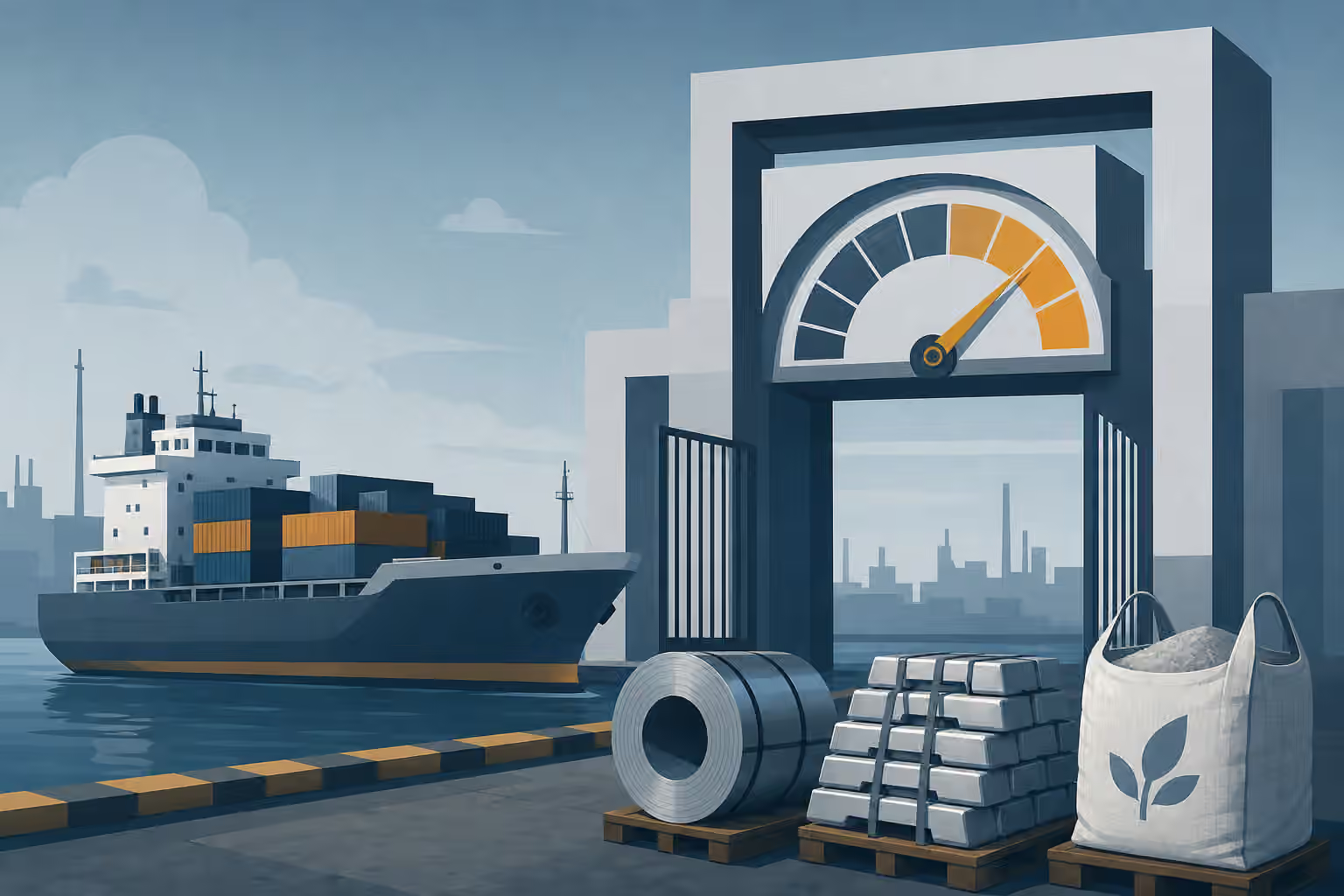
CBAM explained: what the carbon border adjustment mechanism means for exporters
The Carbon Border Adjustment Mechanism puts a carbon price on imports of steel, aluminium, cement, fertilisers, electricity, and hydrogen into the EU. This guide explains how it works, what the definitive phase requires from January 2026, and what non-EU exporters need to do to stay competitive.
This article is for informational purposes only and does not constitute legal advice. Consult a qualified legal professional for advice specific to your situation.
- CBAM ensures that imports of covered goods carry the same carbon cost that EU producers pay under the EU Emissions Trading System. The legal obligation sits with the EU importer, who must purchase and surrender certificates. But the number of certificates required depends on the carbon intensity of the goods being imported, which the non-EU exporter produces and controls.
- The definitive phase began on 1 January 2026. Only authorised CBAM declarants may import covered goods. Certificate purchases are required during the year and surrendered against actual embedded carbon. The first annual declaration covering a full calendar year under the definitive phase is due 31 May 2027, covering 2026 imports.
- Default values are set conservatively and create direct commercial pressure on exporters. If a non-EU exporter cannot provide verified actual emissions data, their EU importer uses default values and pays more in certificates. That cost creates an incentive to either renegotiate price, obtain better data from the current supplier, or find an alternative supplier who can provide it. Investing in the ability to calculate, document, and verify embedded carbon is an investment in being a competitive EU supplier.
- Carbon prices already paid in the country of origin can be deducted from the CBAM obligation. The deduction prevents double-counting where production has already been subject to domestic carbon pricing, but requires documentation of the price paid, the mechanism under which it was applied, and the portion of embedded carbon to which it relates. Exporters in countries with emerging carbon markets should understand exactly what carbon price their production has already been subject to.
What CBAM is and why it exists
The Carbon Border Adjustment Mechanism (Regulation (EU) 2023/956, commonly referred to as CBAM) is a carbon pricing instrument that applies to imports of certain goods into the EU. Its purpose is to address a problem known as carbon leakage: the risk that EU producers, faced with the cost of carbon permits under the EU Emissions Trading System (ETS), move their production to countries with weaker or no carbon pricing, or that EU buyers simply substitute domestically produced goods with cheaper imported equivalents from less regulated markets.
If carbon leakage happened at scale, the EU’s climate policy would be undermined. Production would shift rather than decline. Global emissions would not fall. And EU manufacturers would face a competitive disadvantage relative to producers in countries that have not put a price on carbon.
CBAM addresses this by ensuring that imports of covered goods carry an equivalent carbon cost to the one that would have applied had they been produced in the EU. It does not ban imports. It does not prefer EU producers. It levels the playing field by applying the same carbon price to both.
For non-EU exporters, CBAM has real commercial consequences, even though the legal obligation sits entirely with the EU importer. The EU importer is the authorised declarant: they register, report, and purchase the certificates. But the number of certificates they must buy depends on the carbon intensity of the goods they are importing, which the exporter produces and controls. An EU importer who cannot get reliable emissions data from their supplier falls back on default values, which are set conservatively and result in a higher certificate cost. That cost creates pressure: the importer will either seek to recover it through price negotiation, or find a supplier who can provide the data and reduce their exposure. For the exporter, the consequence is margin pressure or loss of the supply relationship. The mechanism does not put the exporter in the CBAM system, but it does make the exporter’s emissions performance a direct factor in the commercial relationship.
Which goods are in scope
CBAM currently applies to six sectors, chosen because they are the sectors most exposed to carbon leakage risk under the EU ETS framework.
Cement covers all cement clinker and all hydraulic cements, including Portland cement and those used in construction.
Iron and steel covers a broad range of products: iron and steel in primary forms, flat-rolled products, bars and rods, wire, tubes and pipes, and related downstream products. The iron and steel sector is the largest in scope by volume of affected trade.
Aluminium covers unwrought aluminium, aluminium bars, rods, profiles, wire, and certain downstream products including aluminium structures.
Fertilisers covers nitrogen-based fertilisers, including urea, ammonium nitrate, and mixed fertilisers. The nitrogen fertiliser sector is carbon-intensive because the production of ammonia, the feedstock for nitrogen fertilisers, is an energy-intensive process typically powered by natural gas.
Electricity covers electricity imported into the EU via interconnectors. This is a significant inclusion because it addresses the risk of importing electricity generated by fossil fuels to avoid the EU ETS carbon cost.
Hydrogen covers hydrogen in its various forms. Hydrogen is included partly because of its role in decarbonisation: the EU wants to encourage imports of low-carbon or green hydrogen rather than high-carbon equivalents.
The Commission is required to assess whether additional sectors should be included in CBAM by 2026, and further expansion is expected as the mechanism matures. The current list reflects the sectors where the carbon leakage risk was judged most acute at the time of the regulation’s design.
Goods are only in scope when imported into the EU customs territory. Goods that pass through the EU in transit without entering free circulation are not covered.
LIVE TOOL
Check whether the goods you export to the EU fall within scope of the Carbon Border Adjustment Mechanism.
What sector does your exported product fall under?
The transitional period
CBAM was introduced in two phases. The transitional period ran from October 2023 to December 2025.
During the transitional period, EU importers of covered goods were required to register in the CBAM registry and submit quarterly reports containing information about the volume of goods imported and the embedded carbon content of those goods. Embedded carbon means the greenhouse gas emissions generated in the production of the imported goods, measured in tonnes of CO2 equivalent per tonne of product.
No financial payment was required during the transitional phase. Its purpose was to allow importers and their non-EU suppliers to build the capability to measure, verify, and report embedded carbon, and to allow the Commission to gather data on the carbon intensity of goods entering the EU market.
The transitional phase also gave non-EU exporters time to understand the mechanism and begin putting in place the systems they would need for the definitive phase. In practice, not all exporters used that time. Many are now working under significant time pressure.
The definitive phase
The definitive phase began on 1 January 2026. From that date, EU importers of covered goods must purchase CBAM certificates during the year and hand over the number that corresponds to the actual embedded carbon in their imports, at which point those certificates are cancelled.
The CBAM certificate price is linked to the weekly average auction price of EU ETS allowances, expressed in euros per tonne of CO2. This linkage is the mechanism by which CBAM ensures equivalence with the EU carbon price: an importer pays the same carbon price per tonne of CO2 that an EU producer would pay under the ETS.
Only authorised CBAM declarants can import covered goods in the definitive phase. Authorisation requires registration, financial guarantees, and compliance with reporting obligations. An importer that has not obtained authorised declarant status cannot legally import covered goods into the EU.
By 31 May each year, authorised declarants must submit an annual CBAM declaration covering all imports of covered goods in the previous calendar year. The declaration must state the volume of goods imported, the total embedded carbon content, and the number of CBAM certificates handed over to cover that carbon content. Any carbon price paid in the country of origin can be deducted from the certificate obligation.
Certificates that are not surrendered or are surrendered in excess of the actual carbon obligation can be repurchased by the Commission at the original purchase price.
How embedded carbon is calculated
The embedded carbon in a product is the sum of the direct and indirect emissions generated in its production. Direct emissions are those from the production process itself: the carbon dioxide released when iron ore is smelted, for example, or when cement clinker is fired. Indirect emissions are those from the electricity consumed in the production process.
The regulation distinguishes between default values and actual values.
Default values are reference carbon intensities published by the Commission for each product category and country of origin. They are based on average production data and are deliberately set conservatively: they assume a higher carbon intensity than the best available processes, which means that importers relying on default values will generally pay more in CBAM certificates than those who can demonstrate actual lower-carbon production.
Actual values are the measured emissions from a specific production installation, verified by an accredited verifier. An importer who can demonstrate that the goods they are importing were produced with a lower carbon intensity than the default value pays less. This is the core commercial incentive for non-EU exporters to measure and document their own emissions.
The methodology for calculating embedded carbon is set out in Commission implementing regulations. For most product categories, the calculation requires data on the energy inputs to the production process, the carbon intensity of those energy inputs, and the process emissions generated by the chemical reactions involved in production. For operators running large integrated installations such as steelworks, this is a substantial data collection and calculation exercise.
What non-EU exporters need to do
The obligations under CBAM fall primarily on EU importers. It is the EU importer, as the authorised declarant, who is legally responsible for registering, reporting, purchasing certificates, and submitting the annual declaration. Non-EU exporters are not registered in the CBAM system and are not directly liable for the certificate obligation.
However, the practical burden falls significantly on non-EU exporters, because the EU importer’s financial exposure depends on the carbon intensity of the goods they are importing, which the exporter produces and controls.
If an EU importer cannot obtain reliable data on the embedded carbon content of goods they are importing, they face a choice between using default values and paying the higher cost that entails, or declining to import from suppliers who cannot provide the data. Neither outcome is good for the non-EU exporter.
The practical steps for non-EU exporters in covered sectors are as follows.
First, understand whether your goods are in scope. The regulation specifies which CN (Combined Nomenclature) codes fall within CBAM’s scope. If you are uncertain whether your products are covered, the CN code of the goods you export to the EU determines the answer.
Second, establish a method for calculating your embedded carbon. This means identifying all energy inputs to your production process, establishing the carbon intensity of those inputs (including the carbon intensity of the electricity grid in your country or, if you generate your own electricity, the carbon intensity of your generation), and calculating the process emissions from your production chemistry where applicable.
Third, consider third-party verification. The CBAM system allows actual embedded carbon values to be used in place of default values only if they have been verified by an accredited verifier. Getting your emissions data verified is not a legal obligation on the exporter, but it is a prerequisite for your EU importer to use your actual values rather than the default.
Fourth, engage with your EU customers about their CBAM obligations. An EU importer who is paying more in CBAM certificates than necessary because of inadequate emissions data from their suppliers has a strong commercial incentive to either obtain better data or find alternative suppliers. Proactive engagement is in the exporter’s interest.
The carbon price deduction
One of the more important provisions of CBAM for exporters in countries that already operate a carbon pricing system is the deduction for carbon prices already paid.
If a carbon price has been paid in the country of origin for emissions covered by CBAM, the amount paid can be deducted from the EU importer’s certificate obligation. This is intended to prevent double-counting: where a producer has already been subject to a carbon price in their home country, that cost should not be applied a second time through the importer’s CBAM obligation.
The deduction applies to carbon prices paid at the level of the installation or at the national or sectoral level. It requires documentation of the price paid, the mechanism under which it was applied, and the portion of embedded carbon to which it relates. The Commission has published guidance on how to calculate and document the deduction.
For exporters in countries with emerging carbon markets, or in countries where carbon pricing applies to some sectors or installations but not others, the deduction may apply partially. Understanding exactly what carbon price your production process has already been subject to is important for calculating your EU importer’s actual certificate obligation and for making the case to your buyer that you are a competitive supplier.
Country benchmarking and risk classification
The CBAM regulation gives the Commission the power to establish a benchmarking system that classifies countries by the carbon intensity of their production in covered sectors. This system is intended to simplify reporting for countries and sectors where production is verifiably low-carbon.
Countries or sectors that meet equivalence criteria with the EU ETS may be eligible for full or partial exemption from CBAM certificate obligations. This does not mean exemption from monitoring or reporting: the data collection requirements remain. But the financial obligation may be reduced or eliminated for goods from qualifying origins.
How CBAM fits within the broader regulatory landscape
CBAM is part of the EU’s Fit for 55 package, the legislative programme designed to reduce EU greenhouse gas emissions by at least 55 percent by 2030 compared to 1990 levels. It sits alongside the reformed EU ETS, the revised Energy Efficiency Directive, and the Renewable Energy Directive as one of the instruments through which the EU intends to achieve that target.
For businesses affected by multiple EU sustainability frameworks, CBAM is distinct from CSRD and CSDDD in an important respect: it is an economic instrument, not a reporting or due diligence obligation. The obligation is to pay, not to disclose or to conduct a process. The amount paid depends on the carbon intensity of your goods. The mechanism to reduce what you pay is to lower your carbon intensity and to document it accurately.
CBAM and the EU ETS also interact in ways that will evolve over time. As the EU ETS tightens and the carbon price rises, CBAM certificate costs will rise in parallel. The trajectory of EU carbon prices is therefore a factor in the long-term cost exposure of non-EU exporters selling into the EU market.
An overview of how CBAM fits within the broader EU sustainability regulatory landscape is available here: EU sustainability regulation in 2026: an overview of what is now in force.
Key deadlines
- October 2023 to December 2025: Transitional period. Quarterly reporting required, no financial obligation.
- 1 January 2026: Definitive phase begins. Certificate purchase obligations apply. Only authorised declarants may import covered goods.
- 31 May 2026: First annual CBAM declaration due, covering imports in 2025 under the transitional reporting rules.
- 31 May 2027: First annual CBAM declaration covering a full calendar year under the definitive phase (2026 imports).
What to do with this information
If you export goods in covered sectors to the EU, the starting point is confirming whether your specific products are within scope by checking the CN codes listed in the CBAM regulation. If they are, your immediate task is understanding the carbon intensity of your production process and whether your EU customers are already seeking emissions data from you.
If you supply an EU importer who has not yet raised CBAM with you, they are likely to do so. The annual declaration deadline creates an annual pressure point. Importers who are paying more than necessary because of poor supplier emissions data have a recurring commercial incentive to change that situation.
Investing in the ability to calculate, document, and verify your embedded carbon is an investment in being a competitive supplier to the EU market. The mechanism is designed to disadvantage high-carbon production. If your production is genuinely lower-carbon than the default assumptions, demonstrating that accurately reduces your EU customer’s costs and strengthens your commercial relationship.
Frequently asked questions
What is CBAM and who does it affect?
The Carbon Border Adjustment Mechanism (Regulation (EU) 2023/956) is a carbon pricing instrument that applies to imports of certain goods into the EU. It ensures that imports of covered goods carry an equivalent carbon cost to the one that would have applied had they been produced in the EU. The legal obligation sits with the EU importer, but the commercial consequences fall on non-EU exporters because the number of certificates the importer must purchase depends on the carbon intensity of the goods they are importing.
Which goods are covered by CBAM?
CBAM currently covers six sectors: cement (including clinker and hydraulic cements), iron and steel (a broad range including primary forms, flat-rolled products, tubes, pipes, and downstream products), aluminium (including unwrought aluminium, bars, rods, profiles, wire, and certain downstream products), fertilisers (nitrogen-based, including urea, ammonium nitrate, and mixed fertilisers), electricity (imported via interconnectors into the EU), and hydrogen. Scope is determined by CN codes listed in Annex I of Regulation (EU) 2023/956.
When did the CBAM definitive phase begin?
The definitive phase began on 1 January 2026. From that date, EU importers of covered goods must purchase CBAM certificates and surrender them against the actual embedded carbon in their imports. Only authorised CBAM declarants may import covered goods. The first annual CBAM declaration covering a full calendar year under the definitive phase is due 31 May 2027, covering 2026 imports.
What are CBAM default values and why do they matter for exporters?
Default values are reference carbon intensities published by the Commission for each product category and country of origin. They are set conservatively, meaning importers relying on default values will generally pay more in CBAM certificates than those who can demonstrate lower-carbon actual production. If a non-EU exporter cannot provide verified actual emissions data, their EU importer falls back on default values and faces higher costs, which creates commercial pressure on the supply relationship.
Can a carbon price already paid in the exporting country reduce the CBAM obligation?
Yes. If a carbon price has been paid in the country of origin for emissions covered by CBAM, the amount paid can be deducted from the EU importer’s certificate obligation. This prevents double-counting where a producer has already been subject to a carbon price in their home country. The deduction requires documentation of the price paid, the mechanism under which it was applied, and the portion of embedded carbon to which it relates.
Does CBAM apply to goods in transit through the EU?
No. Goods that pass through the EU in transit without entering free circulation are not covered by CBAM. The mechanism applies only to goods imported into the EU customs territory.
What is the CBAM de minimis exemption?
Regulation (EU) 2025/2083 introduced a 50-tonne per importer per year exemption. EU importers whose imports of covered goods from a single supplier fall below 50 tonnes per year may be exempt from CBAM certificate obligations for those goods. The threshold applies per importer, so if you have multiple EU customers, each is assessed separately.
Verdandi monitors CBAM, CSRD, CSDDD, EUDR and more continuously — so you’re working from current requirements as certificate prices move and sector scope expands. Start for free.
Accuracy is a property of a finding. Auditability is a property of the system that produced it. When findings get challenged, accuracy alone is not enough to defend them.