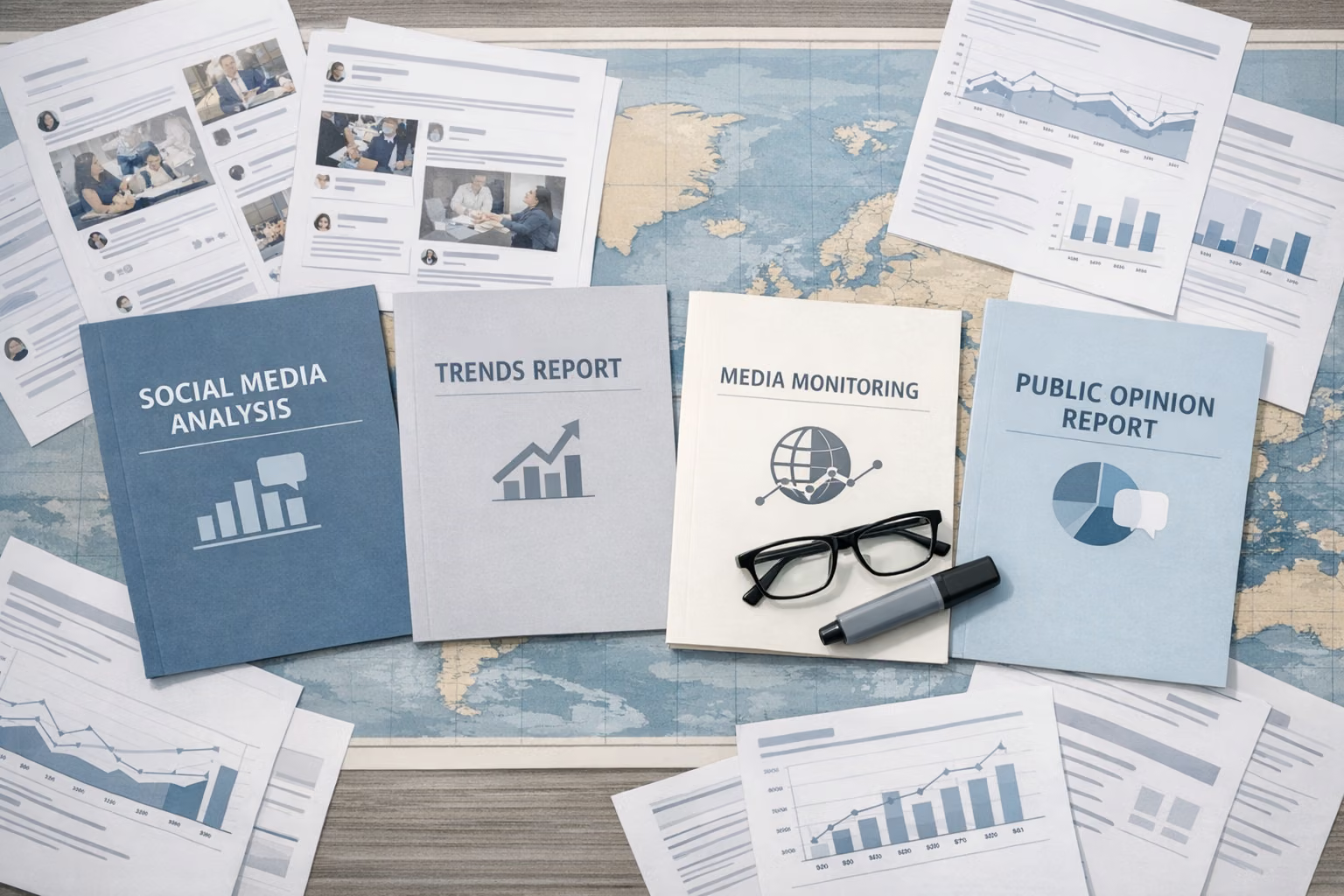
Brandwatch vs Sprinklr vs Synthesio vs Talkwalker: an honest comparison for researchers
Social listening tools are often sold as research platforms, but they are built for brand management. Here is how the four major players compare and where the research gap lives.
The difference between monitoring and research
In most marketing departments, social listening is a synonym for brand protection. It is used to track mentions, manage crises, and measure campaign reach. For a market researcher, the requirements are different. You are not looking for a dashboard of sentiment indicators. You are looking for a representative sample of consumer experience.
The four major players in this space, Brandwatch, Sprinklr, Synthesio, and Talkwalker, all claim to provide consumer intelligence. In practice, they are specialised tools designed for different types of corporate output. Choosing the wrong one typically results in a library of charts that look credible in a monthly report but fail to answer a fundamental research brief.
1. Brand monitoring vs research use cases
The primary divide in this category is between depth of data and breadth of platform.
Sprinklr is a unified customer experience management platform. Social listening is one module in a large suite that includes customer service, social media management, and advertising. It is built for the global marketing function that wants everything in one place. If your goal is to manage hundreds of social accounts and track every mention of your brand, Sprinklr is the infrastructure choice.
Brandwatch and Talkwalker lean toward the insight end of the spectrum. They were built as listening tools first. Their query builders are more sophisticated, allowing researchers to create complex Boolean strings to filter noise. If you are doing category-level research, such as how people talk about sustainable packaging, these tools provide the granularity needed to find signal.
Synthesio, owned by Ipsos, is arguably the most research-oriented of the four. Because of its parentage, it prioritises data cleaning and audience segmentation in a way that aligns with traditional research methodology rather than media monitoring.
2. Source coverage and transparency
For a researcher, a finding is only as good as its source. If a tool reports that sentiment is seventy percent positive, you need to know which platforms that figure came from.
Brandwatch has historically had the strongest archive, particularly for Reddit and X. Its consumer research product allows for deep retrospective analysis.
Talkwalker is often cited for its strength in international markets, news monitoring, and visual content recognition.
Sprinklr has broad reach but can be difficult to audit. The volume of data it processes sometimes makes it hard to trace a finding back to the individual conversations that produced it.
The significant weakness across all four is unbranded source coverage. They are capable at scraping the major social platforms but often struggle with niche forums, community boards, and industry-specific review sites, which is where the most candid qualitative data tends to live.
3. Honest strengths and weaknesses
Brandwatch
The main strength is the query builder. It is the most capable tool for researchers who know how to write complex search strings to isolate specific consumer behaviours.
The main weakness is complexity. It has a steep learning curve and works best with a dedicated operator who knows the platform well.
Sprinklr
The main strength is integration. It connects listening data directly to customer service and marketing workflows, which is valuable for teams that need to act on what they hear.
The main weakness is scale and cost. It is built for large organisations. Contract sizes and implementation timelines make it difficult to use for smaller research teams or one-off projects.
Synthesio
The main strength is data quality. Its social panel features help you understand who is talking, not just what is being said, which brings the data closer to traditional research standards.
The main weakness is pace of development. While robust, it can be slower to integrate new data sources compared to the more technically focused competitors.
Talkwalker
The main strength is real-time visual listening. Its ability to track logos and brand assets in images and video is more advanced than the other platforms.
The main weakness is navigation. The platform has gone through several acquisitions and updates, and the interface can feel fragmented as a result.
4. Pricing and contract models
Pricing is not public for any of the four and is typically based on mention volume or the number of active topics you run. Expect a negotiation process.
Brandwatch and Talkwalker are generally more flexible, with options that work for specialist agencies. Sprinklr and Synthesio are primarily aimed at large enterprise contracts with multi-year commitments.
The unbranded research gap
Social listening tools are designed to answer brand questions. What is our share of voice? How did a campaign perform? They reflect what people say about companies.
Professional research often needs to ask a different question: what are people experiencing in this category, regardless of whether they mention a brand?
If a consumer is frustrated with the process of applying for a mortgage, they might write several paragraphs on a forum describing their experience without naming a single bank. A tool tracking brand mentions will miss that conversation entirely. For a researcher, that unbranded conversation is often the most valuable data in the room. This is a core reason why social listening and consumer research serve different purposes.
This gap is filled by monitoring category experiences rather than brand mentions. Mimir continuously monitors unprompted conversations in forums, communities, and review sites where people describe their problems rather than rating companies, extracting structured themes from that qualitative signal between research cycles. That qualitative depth is what social listening tools are not designed to capture, and it is the market context that exists outside your brand’s own visibility. For a broader look at how this fits into a research programme, see what continuous market research actually looks like in practice.
This article is part of a series on the market research tools landscape. See also: Qualtrics vs Medallia vs Alchemer vs QuestionPro and Dovetail vs Aurelius vs EnjoyHQ.
If you are looking to move beyond brand tracking and into category-level consumer intelligence, Mimir gives you continuous visibility into the unprompted conversations your brand monitoring will never surface. start for free.
Subscribe for news updates.
A practitioner's guide to the leading survey platforms. Beyond the feature tables, here is who these tools are actually built for and where they leave gaps in your research.