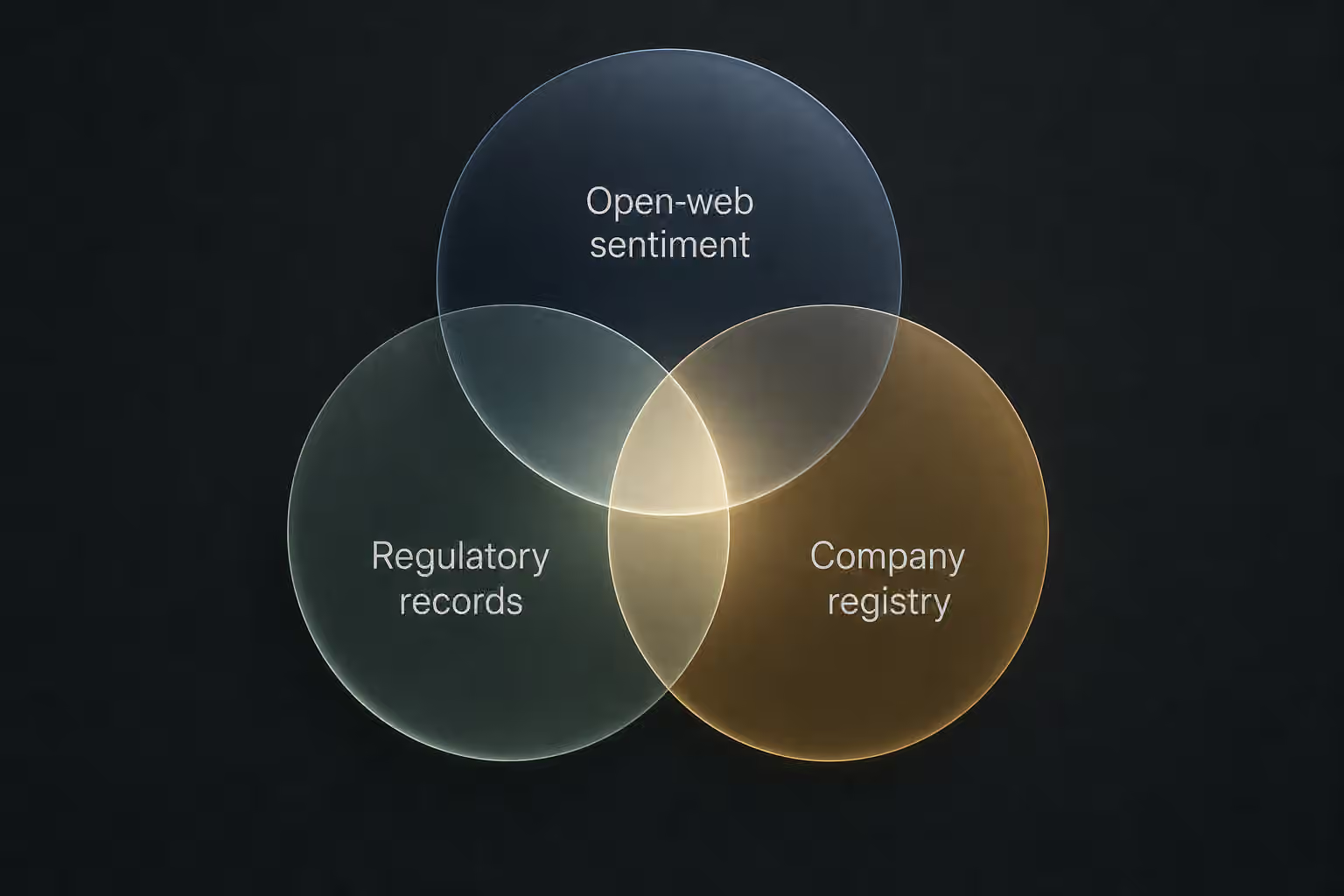
Why sentiment, regulation, and registry signals have to be read together
Each of the three signal layers in investment research is incomplete by design. Open-web sentiment, regulatory exposure, and Nordic registry data each contain things the others cannot. The intersection is where the real signal lives, and reading them separately is how analysts miss it.
The case for triangulation is not about being thorough
There is a version of the triangulation argument that sounds like a completeness argument: check more sources, get a fuller picture. That framing is true but not particularly useful. Analysts already know they should check multiple sources. The problem is that checking multiple sources separately, then synthesising in your head, produces a different result from holding all three simultaneously in a system designed to surface divergence.
The completeness argument says: read the regulatory filings as well as the financials. The triangulation argument says something different: the regulatory filing you just read changes the meaning of the open-web signal you read yesterday, and neither of them means what you thought it meant until you see what the company registry recorded six weeks ago.
That is not a thoroughness point. It is an architecture point. The signals are not additive. They are interpretive. Each one changes what the others mean.
What each layer cannot do alone
The three signal layers covered in the earlier piece on private equity monitoring each have structural limits that are worth restating here because they are the reason triangulation is not optional.
Open-web sentiment is the earliest signal available. Customers, employees, and contractors say things in public forums long before those things appear in audited accounts or regulatory proceedings. The problem is that open-web signal is inherently qualitative and inherently noisy. A theme is not a finding. A pattern of negative employee reviews describing the same management behaviour is a signal that something may be wrong. It cannot tell you what is actually wrong, whether it is material, or what the financial consequence is. It needs context that the other layers provide.
Regulatory records are authoritative and real-time in a way that financial filings are not. An investigation opened today appears in the relevant supervisory database today, not in the next quarterly filing. But regulatory records tell you what a company faces, not how it is performing or what the market thinks of it. A consent order on the record could represent a fully remediated legacy issue or an active systemic problem. The record alone cannot tell you which.
Company registry data, in the Nordic context specifically, is the most underused of the three. Bolagsverket, Brønnøysundregistrene, CVR, and PRH each publish structured data on board composition, ownership, annual accounts, and industry classifications. Registry events, board departures, changes in beneficial ownership, new industry classifications, are documented facts. They are precise and timestamped. What they are not is interpretable in isolation. A board departure is a fact. Whether it is a routine succession, a dispute, or a canary signal for something more significant is a question the registry data cannot answer on its own.
Each layer, read alone, produces a partial picture. The partiality is not a failure of the source. It is the design of the genre.
How the layers change each other’s meaning
The more useful framing is not that each layer adds information. It is that each layer recontextualises the others.
Consider a straightforward example. A Nordic fintech shows stable revenue in its most recent annual accounts. The open-web layer shows a pattern of customer complaints over the past twelve months about unreliable API performance and slow incident response. Read in isolation, the complaints might be explained as the friction of a scaling business. Operational problems during high-growth periods are common and frequently self-correcting.
Now add the regulatory layer. DORA entered full application in January 2025. This company, as a payment institution, is squarely in scope. DORA’s ICT resilience obligations include specific incident classification and reporting requirements, documented third-party ICT risk management, and mandatory resilience testing. The open-web complaints are no longer just a customer experience problem. They are potential evidence of an ICT resilience gap with a specific regulatory consequence. The sentiment signal did not change. Its meaning did.
Now add the registry layer. Six months ago, the company’s chief technology officer departed. The registry records the change without commentary. Combined with the DORA exposure and the customer sentiment pattern, the CTO departure acquires a specific interpretive weight it would not have had on its own. It may mean nothing. It may mean that the person responsible for the ICT architecture left at precisely the moment when that architecture needed to meet new regulatory standards. The registry fact is the same in both scenarios. What it means depends entirely on what surrounds it.
This is what triangulation does that thoroughness cannot. It does not add more data points. It changes what the existing data points mean.
The divergence case is more important than the convergence case
Analysts tend to focus on the convergence case: when all three layers point in the same direction, the picture is clear. Strong financials, clean regulatory history, positive open-web sentiment, no unusual registry events. That is a clean target. The triangulation did not discover anything that a single-layer reading would have missed.
The divergence case is where triangulation earns its value. The target with clean financials, a live regulatory proceeding, and deteriorating sentiment is a fundamentally different risk profile from the one that looks the same on the revenue line. The target with stable revenue, no current regulatory exposure, and a pattern of registry events suggesting significant ownership restructuring over the past eighteen months is telling you something that no single layer reveals.
Divergence between layers is the signal. A target that looks different depending on which layer you read is a target that deserves attention. And the only way to see the divergence is to hold all three layers at the same time, in a system designed to surface the gaps between them rather than present each layer as a self-contained report.
The analyst who reads the financial filing, then the regulatory database, then the registry data, and synthesises across all three in a written memo is doing something genuinely difficult. They are trying to hold three evolving, partially contradictory pictures in memory simultaneously and identify where they do not cohere. That is hard to do well under normal conditions and close to impossible under time pressure in a competitive deal process.
A system that surfaces divergence automatically does not replace that analyst. It gives them the divergence signal directly, so they can spend their time on what it means rather than on finding it.
The Nordic registry layer specifically
The Nordic registries deserve particular attention because they are systematically underused by non-Nordic investors and undervalued even by many Nordic ones.
The registry layer is valuable precisely because it records facts that other layers do not. An annual report tells you what management chose to disclose. An open-web source tells you what people chose to say. A registry record tells you what actually happened and when. Board members joined and left. Ownership transferred. The company changed its primary industry classification. These are documented events, not interpretations.
The delta reading applies here as it does to financial filings. A board that looked the same eighteen months ago and looks materially different today, with three departures and two new appointments in a twelve-month window, is a fact that has a specific weight in the context of what the regulatory and sentiment layers are showing. That weight is invisible if you are reading the registry at a single point in time rather than tracking it continuously.
Why the monitoring cadence matters
The three-layer argument is typically made in a due diligence context. But it applies with equal force to portfolio monitoring, and the monitoring context makes the cadence argument more visible.
In a due diligence context, the analyst assembles all three layers at a point in time. The picture is as current as the research is at the moment of the analysis. In a portfolio monitoring context, the picture keeps moving after the investment is made. The regulatory landscape shifts. Sentiment themes emerge and accelerate. Registry events occur between quarterly reviews.
A portfolio company that was clean on all three layers at acquisition can develop a significant divergence within six months if a regulatory proceeding opens, sentiment deteriorates, and a key executive departure goes unnoticed until the next scheduled review. The divergence does not wait for the review cycle.
Continuous monitoring across all three layers is not the same as reading all three layers at a single point. It is a different architecture entirely, one in which the signal is watched rather than sampled. The analyst’s attention is directed to the divergence when it occurs, not when the next review is scheduled.
For a portfolio of any meaningful size, that distinction is the difference between a monitoring programme that might catch emerging problems and one that will.
The architecture argument restated
The case for reading sentiment, regulation, and registry signals together is not that each adds information to a cumulative picture. It is that each one changes what the others mean, that divergence between them is the finding rather than the individual signals, and that a system designed to hold all three simultaneously and surface the gaps between them does something qualitatively different from a research process in which each layer is read separately.
This is why investment research is a systems problem rather than a search problem. The question is not whether you have access to all three layers. Most analysts do, at least in principle. The question is whether your architecture is designed to read them together, continuously, and to show you when they stop telling the same story.
That is the research infrastructure question that determines whether the intelligence you produce is a collection of data points or an actual finding.
Related reading: The three signal layers every private equity analyst should be monitoring and Why investment research is a systems problem, not a search problem.
Subscribe for news updates.
Sustainability consultants add real value in specific parts of EU compliance work. But much of the early compliance task is interpretation of publicly available legislation that a well-structured approach can handle without external help. This article draws the line honestly.