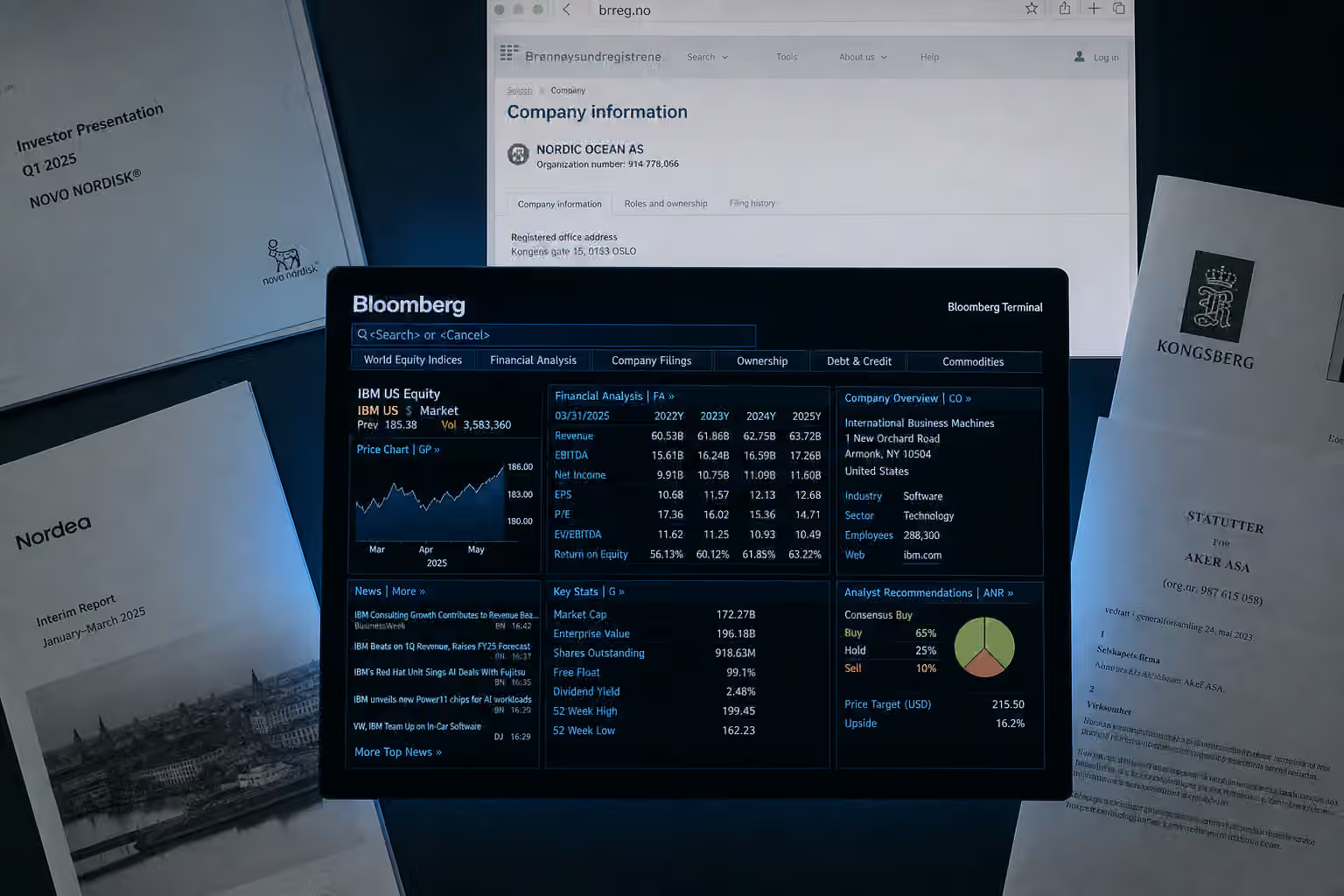
Why investment research tools cost $24,000 a year and what boutique funds can do about it
Bloomberg, Refinitiv, and their peers have built a pricing model that assumes institutional scale. Most of the firms paying for it are subsidising features they never use. Here is what the pricing actually reflects, what it does not, and where the real gap is.
The number that nobody questions
A Bloomberg Terminal costs approximately $24,000 per user per year. A second seat is around $20,000. Refinitiv Eikon, now rebranded as LSEG Workspace, runs at comparable rates depending on the data modules selected. FactSet and S&P Capital IQ operate on similar pricing architectures, with enterprise contracts that obscure the per-seat cost but rarely reduce it materially.
These numbers have become so embedded in the institutional investment landscape that they are rarely examined critically. They are a line in the budget, not a question on the agenda. The terminal is there because the terminal has always been there, because every counterpart has one, and because the alternative: explaining to a limited partner that your fund does not have access to Bloomberg: sounds worse than the invoice.
What is almost never asked is whether the $24,000 is buying what the fund actually needs, or whether it is buying what a bulge-bracket trading desk needs and the fund is receiving a small fraction of that value at full price.
What the terminal pricing model actually reflects
Bloomberg’s pricing was built around a specific user: a sell-side trader or structurer at a large bank who needs real-time price feeds, cross-asset analytics, execution tools, messaging infrastructure, and the ability to move between these functions in a single terminal with millisecond latency.
The Bloomberg Terminal is a genuinely impressive piece of infrastructure for that user. The real-time data, the breadth of coverage, the Bloomberg Chat network that has become the de facto messaging system for institutional fixed income: these things have real value for trading desks operating at scale in liquid markets.
A private equity analyst doing due diligence on a Nordic financial services company does not need any of that.
They need audited financials, which are available from the company registries and from the company directly. They need regulatory exposure, which comes from EUR-Lex, national supervisory databases, and regulatory calendars, none of which Bloomberg aggregates well. They need open-web signal, which Bloomberg does not cover at all. They need company registry data from Bolagsverket, Brønnøysundregistrene, CVR, and PRH, which are public APIs that no major terminal has systematically integrated.
The terminal charges the same price regardless of whether you use it for live rates on forty currency pairs or for pulling an annual report you could have downloaded directly from the filing authority. The pricing model does not discriminate between use cases. The billing does not care that seventy percent of the terminal’s functionality is irrelevant to how you are using it.
The bundling argument and why it holds up poorly
The standard defence of terminal pricing is bundling: you are paying for everything, and the convenience of having everything in one place has value. This is a reasonable argument in principle. Integration has genuine worth. Switching costs between tools are real. A single interface that covers enough of your research workflow is worth a premium over five point solutions.
The bundling argument holds up well when the terminal actually covers your workflow. It holds up poorly when the workflow the terminal covers is not the workflow you have.
For a fund focused on Nordic financial services investments, the terminal workflow is: pull the financial history, look at the news feed, maybe run a comparables screen. The workflow it does not cover: monitor the DORA implementation timeline and identify which portfolio companies have material compliance obligations outstanding; track board composition changes in the Norwegian and Swedish registries and alert when a key executive departs; aggregate open-web sentiment across Trustpilot, Glassdoor, and relevant industry forums and identify when themes are accelerating; cross-reference all three and surface the intersections where signals are diverging from each other.
That workflow: the one that actually determines whether a thesis is sound and whether a portfolio company is developing problems between quarterly reviews: is not in the terminal. It is not in any of the major terminals. The $24,000 is buying access to a workflow that is adjacent to the one that matters and missing the one that does.
What boutique funds are actually paying for
The per-user economics of professional data terminals make reasonable sense at institutional scale. A bank with four hundred analysts each saving thirty minutes a day on data retrieval can justify the cost through productivity alone. The terminal is a shared infrastructure whose price is distributed across a large user base and whose value compounds with usage.
A boutique PE fund with six investment professionals does not have that arithmetic. Six seats at $24,000 each is $144,000 annually. That is a meaningful budget line for a fund where the team size is also the research operation. At that scale, the question of whether the tool is actually serving the research need becomes financially material rather than abstractly interesting.
What boutique funds are typically paying for, when they pay terminal fees, is a combination of three things: the data they actually use, the signal that being seen as a serious institutional investor sends to counterparts and portfolio companies, and the absence of a credible alternative that covers their specific research workflow.
The first is real but overpriced. The second is a legitimate cost of doing business in institutional markets. The third is the gap that matters, because it means the pricing is being set not by competitive pressure from alternatives but by the absence of any alternative to compete against.
The data the terminals have and the data they do not
It is worth being precise about what the major terminals do well, because the argument here is not that they provide no value. It is that the value they provide is specific to a use case that overlaps partially but not completely with what investment research in private markets actually requires.
Real-time price data, historical OHLCV series, corporate actions, earnings calendars, analyst consensus estimates, fixed income reference data, FX rates, commodity prices: this is where the terminals are genuinely strong. If your research workflow depends heavily on market data and you are operating in liquid markets, the terminal earns its cost.
The gaps are structural. Regulatory databases for European financial services are fragmented across national authorities and require domain knowledge to navigate. The terminals provide some regulatory news and some filing aggregation, but coverage of the EU’s regulatory technical standards pipeline, of national supervisory proceedings, of the implementation timelines for instruments like DORA, MiCA, PSD3, and SFDR is thin. A fund trying to assess regulatory exposure in a Nordic fintech acquisition cannot rely on the terminal to tell them what regulatory environment they are buying into.
Company registry data for the Nordic markets is essentially absent from the major platforms. The four Nordic registries, Bolagsverket in Sweden, Brønnøysundregistrene in Norway, CVR in Denmark, and PRH in Finland, each provide free API access to structured data on board composition, beneficial ownership, annual accounts, and company events. None of the major terminals has systematically integrated this data in a way that makes it usable for investment monitoring. An analyst who wants to know whether the beneficial ownership structure of a Norwegian holding company has changed in the past eighteen months is going directly to the registry, not to Bloomberg.
Open-web signal does not exist in the terminal ecosystem. No major financial data provider is systematically aggregating customer reviews, employee forum discussions, and industry community conversations and presenting them as an investment-relevant signal layer. This is not a minor omission. For private companies that do not generate analyst coverage or significant financial press attention, open-web conversation is often the only available signal about operational and management quality between filing periods.
What the pricing gap forces boutique funds to do
The $24,000 terminal creates a specific set of pressures for boutique funds that large institutions do not feel in the same way. A bank with four hundred analysts absorbs the per-seat cost across a user base large enough to make the arithmetic work. A boutique PE fund with six investment professionals faces a materially different calculation. Six seats at $24,000 each is $144,000 annually for a tool whose coverage gaps are then filled manually by the same six people paying for it.
The practical response, for many boutique funds, is a compromise that satisfies neither problem. One or two terminal seats, shared where possible, supplemented by manual searches across sources the terminal does not cover. The registry monitoring happens when someone remembers to check. The regulatory pipeline gets reviewed at deal time rather than continuously. The open-web signal layer does not get checked systematically at all.
This is not a resource problem in the sense that more budget would solve it. It is an architecture problem. The terminal covers a portion of the workflow at a price calibrated for a different user. The portions it does not cover cannot be addressed by spending more on the same tool.
The architecture the terminal workflow is missing
The workflow a boutique fund actually needs for private market due diligence and portfolio monitoring has a different shape from what terminal pricing assumes.
The terminal is built around retrieval: a sophisticated analyst who knows what they are looking for, knows which function to run, and needs the data to come back quickly and completely. That is the right architecture for a liquid markets trading desk where the question is usually specific and the answer is in the data.
Private market due diligence is more often a surveillance problem than a retrieval problem. The analyst does not always know what they are looking for. The question is not “what is the current price of this instrument” but “what has changed about this company in the past six months that I have not been told about.” That question cannot be answered by running a function in a terminal. It can only be answered by a system that has been watching the right sources continuously and surfaces the changes that matter.
The signal sources that surveillance architecture needs to watch are not primarily market data. They are the three layers covered in The three signal layers every private equity analyst should be monitoring: the open-web conversation that surfaces operational and management quality before it reaches the financials, the regulatory exposure that determines what rules a target is navigating and at what cost, and the company registry data that records structural decisions as they are made rather than as they are announced. None of these requires real-time market data infrastructure. All of them require continuous monitoring across sources that update on their own schedules and need to be read in relation to each other rather than in isolation.
The output requirement is also different. A terminal returns data that the analyst then synthesises into a brief. A surveillance architecture for private market research needs to produce structured output that is already synthesised across the signal layers, already links every finding to its source, and already surfaces the intersections where signals are diverging from each other. The source-linked requirement is not a feature preference. In a capital-at-risk context, an investment brief that cannot be traced back to verifiable underlying sources is a liability. If a finding influences a thesis and cannot be checked against its origin, the brief creates uncertainty rather than reducing it.
That is a different architecture from a terminal. It has different infrastructure requirements, a different output format, and a different relationship to the analyst’s time. The analyst’s job in this model is not to retrieve and synthesise but to evaluate and decide, working from structured intelligence that the system has already assembled. That is a better use of the judgment that makes a good analyst valuable, and it is a better match for the research problem that boutique private market funds are actually trying to solve.
The question boutique funds should be asking
The $24,000 terminal is not the price of good investment research. It is the price of the research infrastructure that institutional trading desks needed in a specific era of financial market development. That infrastructure has genuine value for the workflow it was built for.
The question boutique funds should be asking is not whether they can justify the terminal cost, but whether the terminal is covering the research workflow that their investment strategy actually requires. For funds focused on private market transactions, for lean deal teams doing Nordic due diligence, for family offices monitoring a concentrated portfolio without a research department, the answer is increasingly that it is not.
The coverage gaps in terminal data: regulatory pipelines, company registry signals, open-web conversation: are not things that better data analysis skills can compensate for. They are absences, and they leave the research architecture with blind spots that matter in exactly the situations where research quality is most consequential: the deal that looked clean until it did not, the portfolio company whose problems were visible in the signal six months before they appeared in the quarterly numbers.
The research infrastructure a boutique fund needs exists. It is not a terminal. And it does not cost $24,000 per seat.
Related reading: Why investment research is a systems problem, not a search problem and The three signal layers every private equity analyst should be monitoring.
Subscribe for news updates.
Forseti monitors EU financial regulation continuously and delivers personalised horizon-scanning intelligence anchored to verified official EU sources. Here is what it does, who it is for, and why we built it.