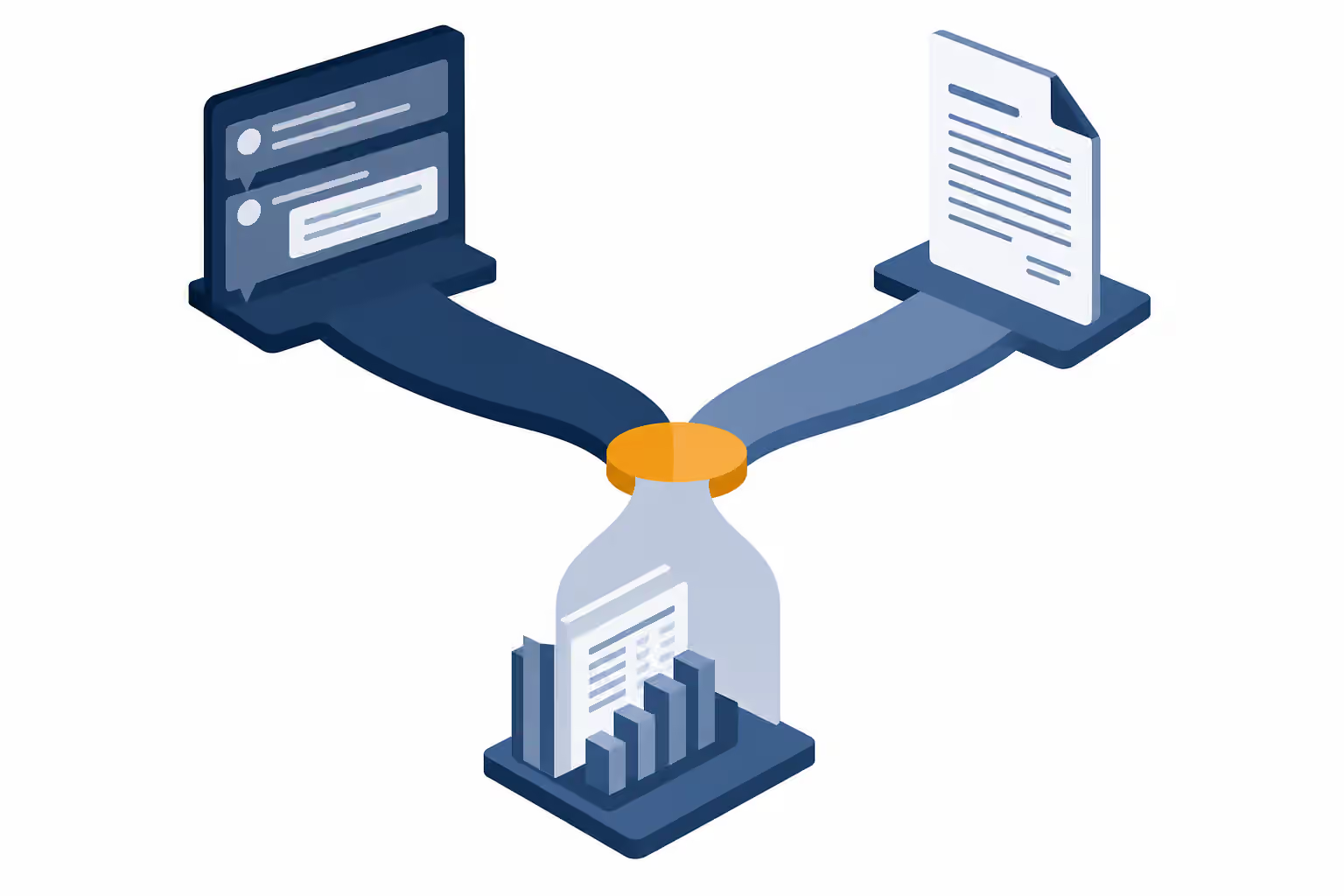
Why investment research is a systems problem, not a search problem
Most investment professionals treat research as a retrieval exercise. Find the right data, read the right filing, ask the right question. The problem is not the question. It is the architecture that surrounds it.
The search framing and why it fails
When an analyst begins research on a potential acquisition target, the instinct is to search. Pull the latest filings. Google the company name. Run a media scan. The framing is: good research is a matter of finding the right things.
This framing is not wrong, exactly. You do need to find things. But it treats research as a retrieval problem when the harder problem is a different one entirely: how do you know when different signals are telling you contradictory things, and which one to believe?
An annual report can show stable revenue while a regulatory filing in a different jurisdiction reveals an investigation that has not yet surfaced in the press. A target company’s employee reviews can signal operational deterioration months before it shows up in financials. A regulatory horizon scan can tell you that the revenue model you are buying is about to face a structural threat that neither the pitch deck nor the audited accounts mention.
None of these signals lives in the same place. None of them, read in isolation, tells the full story. The research challenge is not finding each one. It is building a system that holds all three simultaneously and alerts you when they diverge.
That is a systems problem.
What makes it a system rather than a process
A process is a sequence of steps a person follows. A system is an architecture that produces reliable output consistently, without depending on any individual remembering to do the right thing at the right moment.
Most investment research workflows are processes. An analyst does a media scan, reads the relevant filings, runs a quick sentiment check if they have the tools, and synthesises findings into a memo. The output quality depends entirely on the analyst: their experience, their bandwidth, their ability to hold multiple signal streams in their head at once, and their knowledge of which sources to check for a given target in a given sector.
This works when analysts are experienced, unhurried, and working with familiar asset classes. It works less well when deal flow is high, when targets are in unfamiliar jurisdictions, or when the risk that matters most is the one nobody thought to look for.
A research system does not replace that judgment. It ensures that the inputs to that judgment are complete, current, and structured so that divergence between signal layers is visible rather than buried.
The distinction matters most under pressure. In a competitive deal process, the analyst who is manually searching across disconnected sources is working against a different constraint than the analyst whose system has already flagged that the target has three open regulatory proceedings in two jurisdictions and that employee sentiment has deteriorated significantly in the last quarter. One is still assembling the picture. The other can spend their time evaluating it.
The three layers that have to be read together
There is a reason investment research converged on certain canonical sources: financial filings tell you what a company reports, regulatory records tell you what it owes to and faces from governing bodies, and market intelligence tells you what the world actually thinks.
Each layer has things the others do not.
Financial filings are structured, audited, and comparable. They are also backward-looking by design, and the disclosures that matter most: the risk factors, the related-party transactions and the management discussion of headwinds are written to satisfy legal requirements rather than to inform investors. A skilled reader extracts a lot from an annual report. An unskilled one misses the delta between this year’s risk factor language and last year’s.
Regulatory filings and proceedings are real-time in a way financial filings are not. An investigation, a consent order, a public consultation on rule changes that affect the target’s business model: these are all documented before they reach analyst consensus. They are also distributed across dozens of sources depending on the jurisdiction, the sector, and the nature of the proceeding. No single terminal has all of them.
Open-web conversation captures something neither of the above can: what people say when they are not speaking for the record. Employees describing management decisions on forums. Customers explaining why they left. Contractors discussing contract terms in industry communities. This is qualitative signal, it is noisy, and it is often the first place that emerging problems become visible.
Reading any one of these in isolation produces a partial picture. Reading all three simultaneously, with a system that surfaces divergence between them, is what produces genuine intelligence rather than a collection of facts.
Why the intersection is where the signal lives
The individual signals are not the finding. The finding lives in the relationship between them.
A target company with strong financials, clean regulatory history, and deteriorating open-web sentiment is a different risk profile from one with the same financials, a consent order in progress, and neutral sentiment. The financials, read alone, look the same. The finding is completely different.
This is why triangulation is not just a methodological nicety. It is the mechanism by which the research process generates insight rather than data. Any individual signal can be explained away, contextualised, or simply missed. Three signals that point in different directions from each other cannot be ignored without a conscious decision to ignore them, and that decision becomes visible and defensible in a way that a gap in the research process never is.
The practical implication is that the architecture of the research system matters as much as the quality of any individual source. A system that holds financial, regulatory, and sentiment signals in the same place, updates them continuously, and surfaces divergence between them is doing something qualitatively different from a process in which an analyst checks each source separately and tries to synthesise in their head.
What changes when research is continuous rather than episodic
Most investment research is episodic. It happens at defined moments: initial screening, preliminary due diligence, pre-LOI deep dive, pre-close confirmatory check. Between those moments, the signal keeps moving.
A regulatory investigation can be opened and reach a significant stage between a preliminary and a confirmatory check. Sentiment can shift meaningfully in the weeks after an initial diligence pass. A filing can reveal a material event that changes the thesis between rounds.
Continuous monitoring does not mean reading everything all the time. It means having a system that watches defined targets across defined signal sources and alerts when something changes that matters. The analyst’s time is spent on the alerts, not on the watching.
For portfolio monitoring, the case is even clearer. A fund with twenty portfolio companies cannot run active research on all of them simultaneously. A system that continuously monitors all twenty and surfaces emerging risks across any of the three signal layers is doing work that no team of analysts can replicate manually at that scale.
The shift from episodic to continuous research is not primarily about technology. It is about what kind of intelligence is possible when the monitoring layer does not depend on someone remembering to check.
The architecture argument
None of this requires abandoning the analyst. It requires changing what the analyst is asked to do.
In a search-framed research process, the analyst is responsible for knowing where to look, remembering to look, synthesising what they find, and recognising when signals diverge. That is a lot to hold. And it means that the quality of the research is a function of individual capability and attention rather than of system design.
In a systems-framed research process, the collection and monitoring layer is automated and continuous. The analyst receives structured intelligence with sources cited and divergence flagged. Their job is interpretation and judgment: assessing what the signals mean for the thesis, deciding what needs deeper investigation, and making the call.
That is a better use of the expertise that makes a good analyst valuable in the first place. Pattern recognition at scale is infrastructure. Insight is the analyst’s job.
The firms that will have an advantage in investment intelligence over the next several years are not the ones with the most analysts or the most data subscriptions. They are the ones whose research architecture ensures that every relevant signal is being watched, that divergence between signal layers is surfaced automatically, and that analyst time is concentrated on the judgment calls that actually require it.
That is the difference between treating research as a search problem and treating it as a systems problem. The question is not whether you have access to the right signals. It is whether your architecture is designed to hold them all at once.
Related reading: AI belongs after the data is clean, not before.
Subscribe for news updates.
The debate between RAG and long context is mostly theoretical. Here is what building a production system that uses both deliberately actually taught us about when each approach earns its place.